

Blog
What Is Interprofessional Collaboration? Definition, Framework & Real-World Examples
- By Priya Saravanan
- No Comments


- Published on
- 15 min read

Blog Summary
Interprofessional collaboration (IPC) is when people from different fields work together with shared goals, mutual respect, and accountability not in silos.
Why it matters: Cuts errors by 30–40%, reduces duplication, closes gaps, and enables better outcomes across industries.
Barriers: Silos, poor communication, and fragmented tools that break context. This isn't a communication issue; it's a context crisis with information trapped in siloed tools.
The solution: Interprofessional collaboration built on:
- Shared goals that transcend individual professional agendas
- Mutual respect for each profession's unique knowledge and contributions
- Open communication across disciplinary boundaries
- Collective decision-making rather than hierarchical mandates
- Joint accountability for outcomes and result
This requires infrastructure designed for context, not channels. Tools that unify every email, chat, and file around goals eliminate endless searching-turning your team's collective intelligence into faster, aligned execution.
View more
If you’ve encountered “interprofessional collaboration” before, it was probably in a healthcare context for physicians, nurses, pharmacists, and therapists coordinating patient care. The term emerged from fields where lives depend on coordinated expertise. Interdisciplinary collaboration in healthcare can reduce hospital-acquired infections by up to 20% and MRSA infections by 25% (Medline, 2024); Whether in healthcare, education, social services, or business, the ability of different professionals to work together effectively determines whether complex problems get solved or slip through the cracks.
And… Let’s pause here for a moment. We need to acknowledge something important: no missed deadline, no failed product launch, no budget overrun, however painful compared to a family waiting outside an operating room. Healthcare professionals carry a weight most of us will never fully understand. When their collaboration fails, someone doesn’t come home. When ours fail, we reschedule a meeting.
We’re not borrowing their urgency. We’re borrowing their wisdom.
This comprehensive guide explores what interprofessional collaboration really means, why it matters more than ever in 2026, which frameworks actually work in practice, and how modern tools like Clariti are finally making seamless cross-functional collaboration possible at scale.
What Does Interprofessional Collaboration Mean
Interprofessional collaboration (IPC) is a structured approach where professionals from different disciplines, backgrounds, or specializations work together toward shared goals. It goes beyond simple cooperation or parallel work; it requires active coordination, mutual respect, shared decision-making, and collective accountability.
Characteristics Of Interprofessional Collaboration
In healthcare, IPC might bring together physicians, nurses, pharmacists, social workers, and physical therapists to coordinate patient care. In business, it involves product managers, engineers, marketers, sales representatives, and customer success teams aligning customer outcomes.
The defining characteristics of true interprofessional collaboration include:
- Shared goals that transcend individual professional agendas
- Mutual respect for each profession’s unique knowledge and contributions
- Open communication across disciplinary boundaries
- Collective decision-making rather than hierarchical mandates
- Joint accountability for outcomes and results
Interprofessional collaboration differs from multidisciplinary work, where professionals contribute separately, and from interdisciplinary work, where disciplines blend together. IPC maintains distinct professional identities while creating integrated, coordinated action.
How Did Interprofessional Collaboration Develop as a Concept
The formal study of interprofessional collaboration emerged in healthcare during the 1960s and 1970s as medical complexity increased, and specialization fragmented patient care. Researchers observed that poor coordination between doctors, nurses, and other health professionals contributed directly to medical errors, redundant testing, and patient harm.
By the 1990s, organizations like the World Health Organization (WHO) recognized IPC as essential to improving health outcomes globally. The Institute of Medicine’s landmark 2001 report “Crossing the Quality Chasm” identified teamwork and collaboration as fundamental to patient safety.
In the 2000s and 2010s, interprofessional collaboration frameworks expanded beyond healthcare into education, social work, emergency response, and eventually into corporate environments. Today, IPC principles inform how distributed teams, cross-functional squads, and matrix organizations operate worldwide.
The COVID-19 pandemic accelerated this evolution dramatically. Suddenly, professionals from epidemiology, logistics, communications, public health, data science, and government policy needed to collaborate seamlessly under unprecedented pressure. Organizations that already practiced strong IPC adapted faster and performed better.
Why Interprofessional Collaboration Matters
Benefits of Working Collaboratively Across Professions
According to the Radicati Group workplace productivity report, knowledge workers send an average of 122 emails per day and participate in 11 meetings per week. We’re communicating more than ever.
The real issue is deeper: context fragments as it moves across professions. Interprofessional collaboration delivers measurable advantages that isolated professional work simply cannot match:
- Better problem-solving. Complex challenges rarely fit neatly into one discipline. IPC brings diverse perspectives, methods, and expertise to bear simultaneously, uncovering solutions that single-profession teams would miss entirely.
- Increased innovation. When professionals from different backgrounds collaborate, they combine ideas in novel ways. The intersection of diverse knowledge domains produces breakthrough thinking.
- Higher job satisfaction. Professionals working in well-functioning interprofessional teams report greater fulfillment, lower burnout, and stronger sense of purpose. They feel heard, valued, and part of something larger than their individual role.
- Improved learning and development. IPC creates continuous learning opportunities as professionals observe, question, and absorb expertise from colleagues in other disciplines.
- Enhanced organizational agility. Teams practiced in interprofessional collaboration adapt faster to changing circumstances because they already know how to coordinate across boundaries.
Impact on Shared Outcomes and Collective Performance
Research consistently demonstrates that effective interprofessional collaboration improves outcomes across sectors:
- In healthcare, IPC reduces medical errors by 30-40%, decreases hospital readmission rates, shortens patient recovery times, and lowers overall care costs. Patients receive more comprehensive, coordinated treatment when physicians, nurses, pharmacists, and therapists align with their efforts.
- In education, interprofessional teams of teachers, counselors, administrators, and specialists improve student achievement, particularly for students with complex needs requiring coordinated support.
- In business, cross-functional collaboration accelerates product development cycles, increases customer satisfaction scores, and drives revenue growth. Companies like Spotify, GitLab, and Amazon credit their success to breaking down functional silos and enabling seamless collaboration.
- In emergency response, interprofessional coordination between police, fire, medical, and government agencies saves lives during crises by eliminating communication gaps and duplicated efforts.
How IPC Reduces Duplication, Gaps, and Conflict in Teams
Without structured interprofessional collaboration, teams suffer from three chronic problems:
- Duplication of effort. When professionals don’t communicate, they unknowingly repeat the same work. Marketing creates content that sales doesn’t know exists. Engineers build features product management never requested. Customer support answers the same questions operations already documented.
- Gaps in coverage. Critical tasks fall through the cracks because each profession assumes someone else is handling them. No one takes ownership of cross-boundary responsibilities.
- Professional conflict. Misunderstandings breed resentment. Professionals feel disrespected when others don’t understand their constraints. Territorial behavior emerges as disciplines compete rather than collaborate.
Effective IPC systematically addresses all three problems through clear communication protocols, defined roles and responsibilities, shared visibility into work, and cultural norms that reward collaboration over individual heroics.
Models and Frameworks for Interprofessional Collaboration
Overview of Widely Used IPC Frameworks
Several research-based frameworks guide interprofessional collaboration implementation:
The Interprofessional Education Collaborative (IPEC) Core Competencies identify four domains essential for IPC:
- Values/ethics for interprofessional practice
- Roles and responsibilities
- Interprofessional communication
- Teams and teamwork
The Collaborative Practice Model emphasizes shared power, decision-making, planning, and accountability across professions working toward common goals.
The Integrative Framework for Collaborative Practice developed by the Canadian Interprofessional Health Collaborative focuses on relationship-building, power-sharing, and effective communication as foundations for collaboration.
TeamSTEPPS (Team Strategies and Tools to Enhance Performance and Patient Safety), created by the U.S. Department of Defense and Agency for Healthcare Research and Quality, provides practical tools for improving team communication and collaboration in high-stakes environments.
The Collaborative Practice Continuum: From Cooperation to Integration
Interprofessional work exists along a continuum of increasing integration:
Parallel practice – Professionals work independently on the same case or project with minimal interaction.
Consultation – One professional seeks occasional input from another but retains full decision-making authority.
Coordination – Professionals share information and align timing but still work within separate processes.
Collaboration – Professionals actively work together with shared decision-making, joint planning, and mutual accountability.
Integration – Professional boundaries blur as team members flexibly adopt hybrid roles and shared responsibilities.
Most organizations aim for the collaboration level, where distinct professional identities remain intact while coordination reaches its highest effectiveness. Full integration works only in specific contexts where role flexibility adds clear value.
How to Choose the Right Collaboration Model for Your Context
Selecting the appropriate IPC framework depends on several factors:
- Complexity of the work. Simple, routine tasks require less sophisticated collaboration than complex, novel challenges involving high uncertainty.
- Interdependence between roles. When professionals must coordinate tightly in real-time, you need more structured collaboration frameworks than when work proceeds sequentially.
- Organizational culture and readiness. Hierarchical, siloed cultures require more gradual IPC adoption with clear leadership support. Flatter, more open cultures can implement advanced models faster.
- Available tools and infrastructure. Effective IPC demands technology that makes cross-professional communication and coordination seamless rather than burdensome.
- Regulatory and compliance requirements. Heavily regulated industries may require specific documentation, approval of workflows, and accountability structures that shape which IPC models are feasible.
Barriers to Interprofessional Collaboration and How to Overcome Them
Professional Silos and Role-Based Hierarchies
The barrier: Professionals identify primarily with their own discipline, creating “us versus them” dynamics. Historical hierarchies’ physicians over nurses, product over engineering, sales over customer success perpetuate power imbalances that undermine collaboration.
How to overcome it:
- Leadership modeling. Senior leaders must practice and reward collaborative behavior across professional boundaries.
- Cross-functional projects. Regular rotation through mixed-discipline teams builds relationships and mutual understanding.
- Shared metrics. When all professions are evaluated partly on collective outcomes, not just individual contributions, collaboration becomes rational for self-interest.
- Interprofessional education. Training programs that bring different professions together early establish collaborative mindsets before silos harden.
Communication Breakdowns and Terminology Mismatches
The barrier: Each profession develops specialized jargon and communication norms. What seems clear to an engineer sounds like gibberish to a marketer. Critical information gets lost in translation. Assumptions go unstated because “everyone should know that” except they don’t.
How to overcome it:
- Common language protocols. Establish shared terminology for key concepts and require team members to explain jargon when communicating across disciplines.
- Structured communication tools. Use frameworks like SBAR (Situation-Background-Assessment-Recommendation) that standardize information exchange.
- Communication training. Teach professionals how to communicate effectively with non-specialists in their field.
- Unified platforms. Tools like Clariti that organize communication by topic rather than by channel prevent context from fragmenting across disconnected systems.
Structural and Organizational Obstacles to Collaboration
The Barrier: Organizational structures designed around functional departments physically separate professionals who need to collaborate. Reporting lines, budget allocations, performance reviews, and promotion paths all reinforce siloed behavior. Collaboration becomes extra work rather than core work.
How to overcome it:
- Matrix structures. Create dual reporting relationships where professionals answer both to their functional leaders and cross-functional project leads.
- Dedicated collaboration time. Protect time in calendars specifically for interprofessional coordination rather than treating it as something to squeeze between “real work.”
- Co-location (physical or virtual). When possible, locate collaborating professionals near each other. In distributed teams, create virtual spaces that simulate proximity.
- Aligned incentives. Ensure compensation, recognition, and advancement opportunities reward collaborative contribution, not just individual technical excellence.
Practical Strategies and Tools to Strengthen Interprofessional Teams
Beyond addressing specific barriers, several general strategies strengthen IPC:
Regular interprofessional meetings with clear agendas, rotating facilitation, and documented decisions ensure continuous alignment.
Role clarification exercises where each professional explicitly describes their responsibilities, constraints, and needs from others prevent misunderstanding.
Conflict resolution protocols establish how disagreements will be addressed constructively rather than festering or escalating.
Shared documentation systems give all team members visibility into work progress, decisions made, and pending issues.
Celebration of collaborative wins reinforces that collective success matters more than individual achievement.
Interprofessional Collaboration Tools: A Quick Comparison
The right technology can make interprofessional collaboration seamless. The wrong technology multiplies friction and fragmentation.
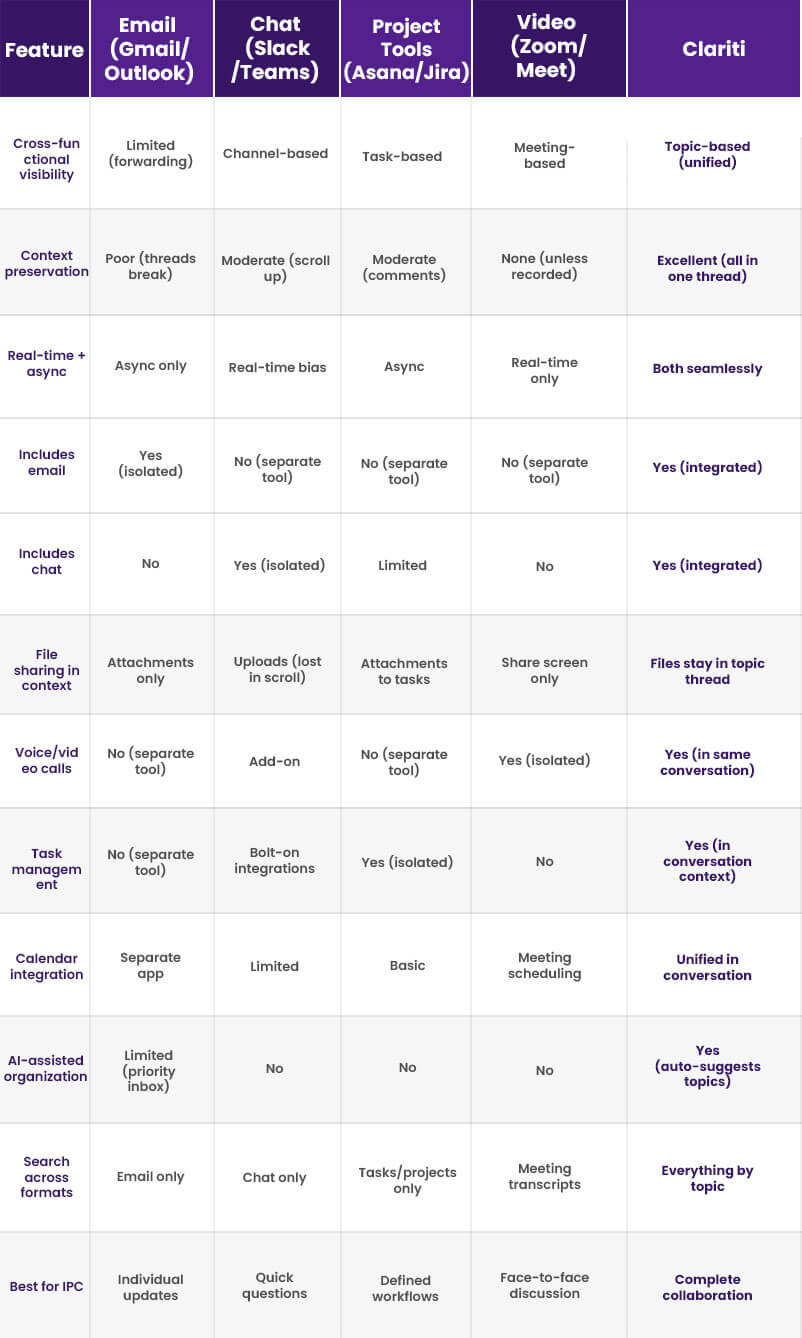
The fragmentation problem: Most organizations use five or more tools to support interprofessional collaboration email for formal communication, Slack for quick questions, Asana for task tracking, Zoom for meetings, and Google Drive for files.
Each tool works adequately for its narrow purpose. But interprofessional collaboration demands something none of them provide: unified context that persists across every communication mode.
When a physician emails a pharmacist about a patient, then discusses it in a Teams chat, references a file in SharePoint, schedules a Zoom call, and creates a task in Asana, the complete context exists nowhere. Every participant must manually reconstruct the full picture by switching between five disconnected systems.
This is exactly what Clariti solves
How Clariti Enables True Interprofessional Collaboration
Clariti is purpose-built for the way interprofessional teams actually need to work—across disciplines, communication modes, and time zones, without losing context or fragmenting conversations.
Instead of organizing work by tool (emails in one place, chats in another, files somewhere else), Clariti organizes everything by topic-based hybrid conversations.
Here’s what that means in practice:
A product manager receives an email from a customer requesting a new feature. She doesn’t forward it to engineering and hope someone reads it. She drops the full email directly into the hybrid conversation dedicated to feature requests.
The lead engineer responds with a chat message right in the same thread, asking clarifying questions. The designer attaches mockup files. The sales director adds context from other customers. The engineering manager creates a to-do with a deadline and assigns it to a developer.
Two weeks later, the customer success representative searches the topic and instantly sees the complete history of every email, every chat, every file, every decision, in chronological order. She knows exactly what was decided, why, and by whom.
No forwarding. No copy-pasting. No context switching. No wondering where the latest version lives.
Why Clariti Is Built for Interprofessional Teams
Unified communication modes: Clariti combines email, chat, voice calls, video calls, file sharing, task management, and calendar events into one conversation chain. Professionals can communicate in whichever mode makes sense without fragmenting the conversation.
Topic-based organization: Instead of organizing by tool or sender, Clariti organizes by the actual subject of collaboration a patient case, a product feature, a client account, a policy initiative. Everything related stays together automatically.
AI-powered context sorting: Clariti’s AI automatically suggests which conversation a new email or message belongs to, eliminating manual sorting and ensuring nothing gets misfiled.
Cross-functional visibility: When an external email from a client comes in, frontline teams can embed it directly into internal conversations. Backend teams who don’t have inbox access can still see the full context and respond through chat or calls.
Async-friendly collaboration: Distributed interprofessional teams working across time zones can participate asynchronously without losing thread continuity. Every team member sees the complete context whenever they log in.
Search by topic, not keyword: Finding information doesn’t require remembering specific words someone used. Search by the topic, and Clariti surfaces every related email, chat, file, call, and task.
Accountability and transparency: Managers can see who contributed what and when, without micromanaging individual tools. Decisions and commitments are visible and documented automatically.
How to Implement Interprofessional Collaboration in Practice
Steps to Build an Interprofessional Team from the Ground Up
- Define the shared goal clearly. What outcome requires interprofessional collaboration? Be specific. “Improve customer satisfaction” is vague. “Reduce customer support ticket resolution time from 48 hours to 24 hours” is actionable.
- Identify which professions must collaborate. Map out whose expertise, authority, or execution capacity is essential to achieving the goal.
- Clarify roles and responsibilities explicitly. Each professional should understand their unique contribution and how it depends on others. Use RACI matrices (Responsible, Accountable, Consulted, Informed) to eliminate ambiguity.
- Establish communication norms. How often will the team meet? What decisions require consensus versus individual authority? How will disagreements be resolved? Where will information be documented?
- Select collaboration tools purposefully. Choose technology that unifies rather than fragments communication. A tool like Clariti that keeps all conversation modes in context eliminates the most common source of interprofessional friction.
- Create psychological safety. Team members must feel safe admitting uncertainty, asking questions, and challenging ideas without fear of professional judgment or retaliation.
- Start with a pilot project. Test interprofessional collaboration on a contained initiative before scaling broadly. Learn what works in your specific context.
Creating Shared Goals, Protocols, and Accountability Structures
Interprofessional collaboration fails when team members pursue conflicting goals or lack clear accountability.
Shared goals must be outcome-oriented and measurable. They should require contributions from multiple professions goals that any single discipline could achieve alone don’t demand true collaboration.
Protocols establish how work flows between professions. Who initiates? Who reviews? Who approves? Who executes? Who communicates outcomes? Document these sequences explicitly.
Accountability structures ensure follow-through. Use shared dashboards, regular check-ins, and transparent documentation so everyone knows who committed to what and whether it happened.
Tools and Technologies That Support Collaborative Work
Beyond Clariti’s unified workspace, several supporting technologies enhance interprofessional collaboration:
Shared knowledge bases like Notion or Confluence capture institutional knowledge that all professions can access.
Visual collaboration tools like Miro or Mural enable synchronous brainstorming and planning across disciplines.
Data dashboards like Tableau or Looker provide shared visibility into performance metrics that drive collaborative decision-making.
Workflow automation through tools like Zapier reduces manual handoffs between professions.
The key is integration. Tools should connect seamlessly rather than creating more silos. This is why all-in-one platforms like Clariti often outperform fragmented tool stacks for interprofessional teams.
How to Measure Interprofessional Collaboration Success
Key Indicators of Successful Interprofessional Collaboration
Effective IPC produces measurable improvements:
Process indicators:
- Communication frequency and quality across professions
- Time spent in collaborative activities
- Number of professionals actively contributing to shared goals
- Speed of information flow between disciplines
Outcome indicators:
- Goal achievement rates
- Error and rework reduction
- Time to completion for collaborative projects
- Cost efficiency improvements
Experience indicators:
- Team member satisfaction and engagement scores
- Professional development and learning
- Retention rates
- Conflict frequency and resolution speed
Assessment Tools and Validated Measurement Frameworks
Several validated instruments measure interprofessional collaboration:
The Interprofessional Collaboration Scale (ICS) assesses communication, accommodation, isolation, and collaboration across professions.
The Team Climate Inventory (TCI) measures participative safety, support for innovation, vision clarity, and task orientation.
The Assessment of Interprofessional Team Collaboration Scale (AITCS) evaluates partnership, cooperation, and coordination.
The Collaborative Practice Assessment Tool (CPAT) focuses on governance, leadership, and administrative support for collaboration.
Organizations should select measurement approaches that align with their specific IPC goals and regularly assess progress.
What the Research Evidence Says About IPC Effectiveness
Decades of research across sectors confirm that effective interprofessional collaboration improves outcomes:
A 2019 Cochrane Review found that interprofessional collaboration interventions in healthcare improved patient satisfaction, reduced clinical errors, and decreased hospital stay length.
Research published in the Journal of Interprofessional Care demonstrated that teams with higher IPC competency achieved 23% better patient outcomes than those with lower competency.
Business research shows that companies with strong cross-functional team collaboration bring products to market 30-50% faster and achieve 15-20% higher customer satisfaction scores.
The evidence is clear: investing in interprofessional collaboration delivers measurable returns.
Conclusion
Interprofessional collaboration is no longer optional. In healthcare, education, business, and every other sector, complex challenges demand coordinated expertise from multiple professions working in genuine partnerships.
The framework exists. The research validates the approach. What has held organizations back is the difficulty of implementation of professional silos, communication barriers, and fragmented tools that make collaboration feel harder than working alone.
Technology is finally catching up to what interprofessional teams actually need.
Clariti eliminates the tool fragmentation that sabotages collaboration. It brings emails, chats, files, calls, tasks, and calendar events into unified, topic-based conversations where context never fragments, and nothing falls through the cracks.
For teams serious about interprofessional collaboration, the question is no longer whether to collaborate. It’s how to do it without chaos.
Ready to experience what seamless interprofessional collaboration feels like? Try Clariti free today and discover how the world’s most effective cross-functional teams stay aligned, informed, and productive without switching between a dozen disconnected tools.
Frequently Asked Questions
What is interprofessional collaboration?
Interprofessional collaboration (IPC) is a structured approach where professionals from different disciplines work together toward shared goals.
What are the core principles of interprofessional collaboration?
The core principles include: Mutual respect, shared responsibility for outcomes, open and honest communication, understanding of roles and responsibilities, patient/client-centered focus, and commitment to continuous learning and improvement.
What is the difference between IPC and teamwork?
Teamwork can occur within a single profession or discipline. Interprofessional collaboration specifically involves multiple distinct professions working together.
What skills are needed for interprofessional collaboration?
Essential skills include: Active listening, clear communication across disciplinary boundaries, conflict resolution, flexibility and adaptability, cultural competence.
How is interprofessional collaboration taught and learned?
IPC is taught through interprofessional education (IPE) where students or professionals from different disciplines learn together.
Why is interprofessional collaboration important?
IPC improves outcomes by bringing diverse expertise to complex problems, reduces errors and gaps in service, eliminates duplication of effort, increases innovation, enhances job satisfaction, and creates more comprehensive solutions than any single profession could achieve alone.
What are the key skills needed for interprofessional collaboration?
Key skills include communication across professional languages, role clarification, conflict navigation, shared decision-making, mutual respect, flexibility in approach, cultural competence, and the ability to use collaborative tools.
What are the main barriers to interprofessional collaboration?
Major barriers include professional silos and hierarchies, communication breakdowns, conflicting terminology, structural obstacles like separate departments and budgets, incompatible technology systems, lack of leadership support, unclear roles and responsibilities, and organizational cultures that reward individual over collaborative achievement.
How is interprofessional collaboration taught and developed?
IPC competency develops through formal interprofessional education programs, structured team experiences, mentorship and role modeling, simulation training, reflection on collaborative practice, feedback from team members, and continuous exposure to diverse professional perspectives.
How do you measure the effectiveness of interprofessional collaboration?
Effectiveness is measured through validated tools like the Interprofessional Collaboration Scale, Team Climate Inventory, and CPAT assessment.




Start for FREE with Personal CRM
We too hate spam! Your email is secure with us.

Spot secured. You're in.
You’re officially on the list for early access to Clariti.


No more switching tools.

No more lost context.

Just Clarity.
You’ll be among the first to experience it when we launch. We’ll let you know the moment it’s ready.

Keep an eye out for emails from @clariti.app.
(and check your spam folder just in case—whitelisting us helps ensure you don’t miss a thing).