

Blog
The Rise of Interoperable Messaging: How Instant Messaging Apps Are Rewiring Workplace Speed
- By Clariti Team
- No Comments


Blog Summary
Workplace communication is quietly shifting from email to fast, AI‑powered messaging and interoperable platforms
- Business messaging use has surged 50% as hybrid teams find email too slow.
- Slack, Teams, and WhatsApp now add AI summaries, action items, and priority signals.
- Companies are cutting 30–40% of recurring meetings with clearer async updates.
- Tools like Clariti pull conversations from apps like Microsoft Teams and Slack into one contextual workspace, reducing chaos.
Key takeaway
The winners won’t just be the fastest app. They’ll be the systems that keep communication cross‑platform, searchable, private, and accountable.
View more
“The beginning is always today,” Mary Wollstonecraft wrote. Sometimes the ground doesn’t shake – it simply shifts. Quietly. Almost politely. As if asking permission to rewrite the rules we were standing on.
Over the past year, we’ve watched that happen to workplace communication.
No big announcement. No dramatic collapse. Just numbers quietly pointing in a new direction:
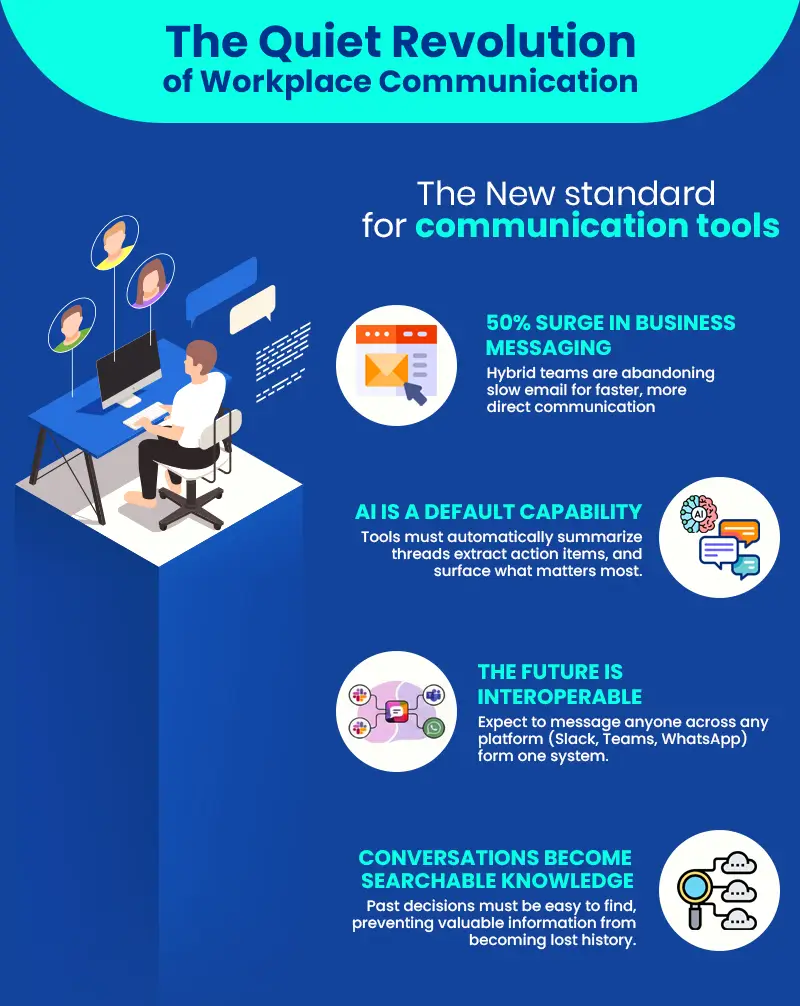
- Business messaging adoption up more than 50%, as hybrid teams admit email is too slow for modern work.
- WhatsApp testing cross‑platform messaging in Europe under the DMA, hinting at a future where platforms have to talk to each other.
- Slack, Teams, and WhatsApp rolling out AI summaries, action extraction, and priority signals, turning loose chat into something closer to structured workflows.
- Companies cutting 30–40% of recurring meetings because async updates are finally clear enough.
- Gen Z nudging teams toward shorter, sharper, more immediate exchanges.
The shift didn’t roar. It unfolded.
But the landscape underneath work is different now.
This article looks at that quiet revolution and offers five practical ways to reduce chaos and build a clearer, more effective communication system around it.
1. What the “new normal” of business communication apps will need to offer
If messaging becomes the core channel for work, the tools that survive won’t just be chat windows. They’ll have to operate more like operating systems for communication.
a. Interoperability and a “network of networks”
We’ve seen more leaders ask versions of the same question: “Why can’t my tools talk to each other the way people talk to each other?”
With moves like WhatsApp’s DMA-driven interoperability tests in Europe, expectations are shifting:
- People will expect to message across platforms (WhatsApp ↔ Messenger ↔ others, possibly even email gateways).
- Companies will want a unified messaging layer—one place where internal, external, and customer conversations can be handled, regardless of the app being used on the other side.
- Being locked into a single walled garden is getting harder to defend.
Emerging expectation:
“Let me talk to anyone, from any app, and still have my system log, secure, and organize everything.”
b. AI as a default capability, not a bolt‑on
We’ve watched Slack, Teams, WhatsApp and others quietly normalize AI as part of everyday communication:
- Summaries and catch‑up for long threads, channels, and meetings.
- Action extraction that turns “Can you send the deck by Thursday?” into structured tasks.
- Priority signals that surface mentions, decisions, and blockers instead of every notification.
These are no longer “wow features”; they’re becoming table stakes.
Emerging expectation:
“Don’t just store conversations; structure them and surface what matters.”
c. Embedded workflows, not just messages
In many organizations we’ve observed, chat has started acting as the front-end for work:
- Approvals (PTO, expenses, content) happening directly inside chat with simple workflows.
- Bots pulling data in from Jira, Salesforce, Notion, and pushing updates back.
- Cadence templates for standups, incident response, status updates, etc.
Emerging expectation:
“Let me move from conversation to action without hopping across six different tools.”
d. Compliance, security, and boundaries by design
As WhatsApp-style messaging turns into a business norm, we’ve seen security and compliance teams get much louder in the conversation:
- Strong admin controls: retention, export, legal hold, and detailed audit trails.
- Clear separation of personal vs. work identity (managed accounts, work profiles).
- Built-in support for quiet hours and focus modes to counter “always-on” culture.
Emerging expectation:
“Give me fast communication—but inside clear guardrails that protect my data and my time.”
e. Searchable memory instead of ephemeral chaos
We’ve watched teams hit the same wall: fast chat is great until nobody can find the decision that was made three weeks ago.
The organizations that cope best tend to look for:
- Global, unified search across messages, docs, calls, and tasks.
- Conversation structures (threads, topics, channels) that don’t collapse into one noisy feed.
- AI that can answer questions like, “What did we decide about X?” without 20 minutes of scrolling.
Emerging expectation:
“Past conversations should become searchable knowledge, not lost history.”
2. How work culture is likely to change
When messaging + AI + async becomes the default stack, we’ve seen culture tilt in both promising and risky directions.
I. The upside we keep noticing (Pros)
a. Faster decision cycles
- Questions that took days over email get resolved in minutes.
- Short async updates make many recurring status meetings unnecessary.
b. More inclusive, global collaboration
- Async channels make it easier to work across time zones.
- Quieter or junior team members often contribute more in written threads than in live calls.
c. Flatter, more transparent organizations
- Open channels let people see discussions and decisions that used to be locked in private inboxes.
- Leaders become more visible and accessible in shared spaces.
II. The downside we’ve watched teams struggle with (Cons)
a. Hyper-responsiveness and burnout
- Without clear norms, people feel they must respond instantly and stay “online” 24/7.
- Notification fatigue leads to anxiety and context-switching.
b. Shallower thinking and rushed decision
- Fast messaging can crowd out deep, well-reasoned writing and reflection.
- Teams sometimes optimize for speed rather than clarity or good judgment.
c. Fragmented knowledge
- Critical decisions get trapped in scattered threads instead of being captured in a durable place.
- People end up asking, “Was that in Slack? Email? WhatsApp? A doc somewhere?”
d. Erosion of writing skills
- Over-rotating to extremely short, informal messages can weaken the discipline of clear, structured writing.
- That becomes a problem when teams need specs, postmortems, or long-term strategy docs.
III. Cultural adaptations we’ve seen high-performing teams make
To avoid “faster chaos,” the best teams we’ve observed put deliberate norms around their tools:.
a. Clear “what goes where” rules
- Chat for quick questions, coordination, and lightweight decisions.
- Docs/wiki for specs, strategy, and durable knowledge.
- Tickets for execution and tracking work.
b. Explicit response-time expectations
- Example: “Team channels: respond within 4 business hours. No expectation outside local working hours.”
- This reduces the unspoken pressure to always be “on.”
c. Default-to-async rituals
- Written weekly updates instead of status meetings.
- Recorded demos instead of mandatory live attendance.
- Written briefings before important decisions.
d. AI literacy and healthy skepticism
- “AI summaries are helpers, not ground truth.”
- For high-stakes topics, people still go back to the original conversation or document.
3. How your four signals fit into this picture
You highlighted four trends; we’ve seen versions of all of them in practice.
a. Messaging adoption is up 50% because hybrid teams can’t wait for email
This mirrors what we’ve watched inside many organizations:
- Email remains useful for formal and external communication.
- Internally, it’s often too slow, too siloed, and too easy to ignore.
But when companies simply move everything from email to chat without structure, the underlying problems information overload, lack of clarity tend to follow them.
b. AI summarization, action extraction, and priority signals in Slack, Teams, WhatsApp
We’ve seen these capabilities make a real difference when used well:
- They cut down on message fatigue and the fear of missing something important.
- Async work becomes more realistic; people can disconnect and catch up quickly.
The risk we’ve noticed: when teams over-trust AI output for sensitive or nuanced topics, misunderstandings creep in. The most thoughtful orgs set clear rules about when a summary is enough and when the original thread needs to be read.
c. Companies cutting meetings by 30–40% as async updates replace recurring calls
We’ve seen this play out as one of the most tangible wins:
- Less calendar clutter and “performative “busyness”.
- More focus time for deep work.
But there’s a trap: if recurring meetings simply turn into endless chat threads, nothing really improves. The teams that actually benefit pair fewer meetings with better documentation not just more messages
d. Gen Z pushing communication toward fast, informal messaging
Culturally, this is already visible in a lot of workplaces we’ve observed:
- Gen Z is extremely fluent in high-frequency, multimodal communication.
- That brings energy, immediacy, and a comfort with async collaboration.
The gap appears when organizations forget they still need:
- Clear specs, decision docs, and postmortems.
- Training for younger employees on when fast messaging is fine and when deeper, structured writing is essential.
The healthiest cultures we’ve seen blend Gen Z’s speed and informality with strong habits around documentation and written clarity.
4. How teams can prepare for this future
Based on what we’ve seen across different companies, a few practices consistently help:
a. Deliberately narrow the tool stack
One primary internal chat, one knowledge system, one work-tracking system—tightly integrated.
b. Define communication norms early
- When to use chat vs. docs vs. tickets.
- Response-time expectations.
- Off-hours and availability rules.
c. Institutionalize decision logs
Every major decision gets a brief written record, linked back from the original conversation.
d. Use AI aggressively, but with human accountability
Summaries, action extraction, translation, prioritization, but humans own the decisions.
e. Continue to invest in writing skills
Even in a chat-first world, clear writing is what lets organizations scale async work without losing coherence.
5. Where this trajectory is headed (and where Clariti fits)
A workplace built on interoperable messaging, AI-structured conversations, and cross-platform communication isn’t a distant idea anymore; it’s the trajectory. And when that becomes the norm, the burden shifts from “Which app do we chat in?” to “Which system preserves clarity, privacy, and context when everything is moving this fast?”
Most tools weren’t designed for that kind of world. They were built for speed, not accountability. For messages, not memory. For convenience, not governance.
And this is where the next era of communication platforms will differentiate themselves not by adding more channels, but by becoming context engines that let teams work across platforms without losing the story, the decision, or the audit trail underneath it.
From that perspective, we’ve seen Clariti lean into this interoperability shift with its ability to connect directly with Microsoft Teams and Slack inside the workspace via a recently acquired integration capability not as just another chat window, but as a way to let conversations flow in while keeping the context intact. It’s a small glimpse of what tomorrow’s communication stack will require.
Conclusion
Because if this becomes the new normal, the expectations will rise across the board:
- Privacy must be engineered.
- Workflows must be explicit.
- AI must be accountable.
- Decisions must be traceable and communication must work across platforms, not just inside them.
The companies that get this right will operate with a kind of ambient clarity — fewer meetings, faster alignment, quieter teams, sharper decisions.
The rest will still be digging through inboxes, wondering where the project went sideways.
If the world is moving toward fast, structured, cross-platform communication, then only the tools that honor privacy, preserve context, and handle complexity with intelligence will remain essential. Everything else becomes noisy.
And as Wollstonecraft reminded us, “the beginning is always today,”.


Start for FREE with Personal CRM
We too hate spam! Your email is secure with us.

Spot secured. You're in.
You’re officially on the list for early access to Clariti.


No more switching tools.

No more lost context.

Just Clarity.
You’ll be among the first to experience it when we launch. We’ll let you know the moment it’s ready.

Keep an eye out for emails from @clariti.app.
(and check your spam folder just in case—whitelisting us helps ensure you don’t miss a thing).