

Blog
A Manager’s Guide to Organizing Chaos: From Scattered Apps to Structured Conversations
- By Clariti Team
- No Comments

As a manager, your day is a constant stream of questions: “What’s the status of Project X?” “Where did we leave off with the client?” “Who is handling the final deliverable?”
You aren’t just managing people; you’re managing conversations. And when those conversations are scattered across multiple apps, you’re not leading; you’re playing detective. This chaos isn’t just frustrating; it’s a direct threat to your team’s velocity and your own effectiveness.
The core management challenge isn’t a lack of effort from your team. It’s the lack of a unified system, a conversation architecture that provides the visibility and context needed to lead effectively. This is about moving from managing noise to orchestrating clear, actionable workflows.
Digital Disorganization: The Hidden Toll on Managers and Teams
For a manager, the cost of scattered apps is measured in more than just lost minutes. It’s measured in missed deadlines, duplicated work, and eroded accountability.
Point of View: Managers are often the hub of information, yet they’re forced to operate with a fragmented view. Each platform holds fragments of conversations email here, chat there, files lost in drive folders. This lack of a single source of truth turns leadership into a constant game of catch-up, undermining strategic focus and team trust.
What you’re left managing isn’t collaboration. It’s confusion with good intentions. And it’s costing more than you think.
The Hidden Time Tax
Managers lose an average of four hours a week searching for information across disparate tools, according to a Panopto study. That’s over 200 hours a year spent on administrative work, not strategic leadership.
Research shows that constant app-switching and context-shifting creates significant “digital drag” that managers must constantly combat.
When multiplied across a team of eight, that’s an entire role’s worth of time lost not to strategy or innovation, but to scavenger hunts.
The Context Switching Penalty
Research from the University of California shows it takes 23 minutes to regain focus after every interruption. With managers toggling between 15–20 apps per hour, context switching becomes the silent productivity killer.
Each switch fractures thought. Deep work becomes impossible.
The Accountability Gap
When conversations scatter across platforms, ownership disappears. The client request in your inbox never connects to the project update in Slack or the delivery deadline in Asana.
The result: Missed milestones. Duplicated work. And the subtle erosion of trust.
Diagnosing Your Team’s Communication Chaos
Before you fix the problem, name it. Most teams fall into one of these patterns:
- The Silo Syndrome: Each department clings to its preferred tools. Sales in CRM, Marketing in Trello, Engineering in Jira. Information flows inward, rarely outward.
- The Replication Plague: The same document exists in five versions. Feedback loops multiply. Nobody knows which version is final or why decisions were made.
- The Notification Avalanche: Every ping carries equal urgency. “Lunch menu” competes with “client escalation.” Teams drown in low-value noise, missing what truly matters.
The Manager's Blueprint: Architecting Clarity with Context-Based Conversations
Your team doesn’t need more monitoring; they need a better system. The solution is to replace app-centric chaos with context-based clarity.
The Four-Step Framework to Restore Clarity
To move from chaos to control, build hybrid conversations. A unified space where conversations, context, and accountability live together.
Step 1: Conduct a Communication Audit
For one week, have your team log:
- Tools they use and for what purpose
- Average number of app switches per day
- Time wasted searching for data or decisions
- Notification types that derail focus
When one team tracked this, they discovered 14 tools used for a single project. The audit will reveal your blind spots and your biggest time leaks.
Step 2: Implement a Triage Protocol
Not all communication is equal. Use this priority matrix:
|
Priority
|
Channel
|
Example
|
|---|---|---|
|
Urgent + Important
|
Call or Direct Message
|
Crisis response
|
|
Important, Not Urgent
|
Project Channel
|
Strategic updates
|
|
Urgent, Less Important
|
Chat
|
Quick questions
|
|
Neither
|
Email
|
Announcements, newsletters
|
This structure trains your team to think before they send and respect attention as a shared resource.
Step 3: Create a Single Source of Truth
Each project or client should have one home where:
- All decisions are logged
- All related files are stored
- All ownership is visible
- All progress is trackable
If it’s not in the command center, it doesn’t exist.
Clariti, an AI-powered hybrid communication tool, takes this concept further by grouping emails, chats, calls, and files by context creating a context-based hybrid conversation for every project.
Learn how Clariti organizes hybrid conversations works
Step 4: Preserve Context in Every Conversation
Context turns communication into collaboration. Every message should clarify:
- What are we discussing?
- Why does it matter?
- Who owns it?
- When is it due?
Without these, conversations drift and accountability dissolves.
From Blueprint to Action: How Managers Can Architect Clarity with Context-Based Conversations
Theory only takes you so far. The real transformation happens when clarity becomes a daily habit not a one-time fix. Here’s how to put your new framework into motion.
Putting It into Practice
Start small.
In Week 1, pilot the system with one project. Observe what feels smoother and what still drags. The goal isn’t to overhaul everything it’s to notice friction points and wins.
By Week 2 and 3, move into normalization. Begin every team meeting with your “command center” view where communication, files, and updates live in one space. Redirect side chats or scattered notes back to this hub. Within days, you’ll see fewer “where did we discuss this?” moments.
In Week 4, pause to review. Measure what’s working. Are updates clearer? Are meetings shorter? Once patterns stabilize, scale the approach to more teams or larger projects.
You’re not chasing perfection; you’re building predictable clarity.
The Tangible Impact of Clarity
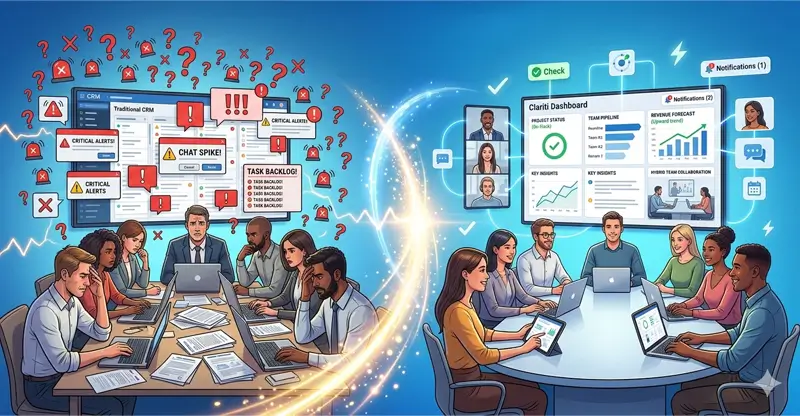
Chaos is exhausting and it shows in every meeting, every email, every chat notification. Take a product launch, for example. The marketing manager is emailing agencies, engineers are scattered across multiple chat apps, and the designer is sharing files separately. You’re the manager, piecing together the puzzle, constantly switching apps, and feeling like a human switchboard.
Now imagine a unified workspace. External communications link directly to internal discussions. Updates live in context-based hybrid conversations. Final assets and decisions are stored in one searchable location. Suddenly, you can see the full picture in real time. You know exactly how client feedback connects to team action and ultimately, the final deliverable.
The results are tangible:
- Shorter meetings: 30–40% less time spent syncing.
- Faster onboarding: New team members understand workflows in days, not weeks.
- Time reclaimed for managers: Hours previously lost searching for context are now spent on meaningful decisions.
- Boosted morale: Confusion drops, confidence rises, and teams focus on real impact.
This isn’t just theory. Context-based communication turns managers from reacting to chaos into leading with clarity. Teams stop chasing scattered information and start delivering with purpose.
Sustaining the System
A system is only as strong as its maintenance rhythm.
- Monthly: Review what tools and habits are working. Adjust before clutter returns.
- Quarterly: Archive or clean up inactive projects. A lean workspace signals focus.
- Ongoing: Lead visibly. When leaders use and respect the system, teams mirror the behavior.
Building structure isn’t a one-time sprint it’s a leadership habit that compounds.
Orchestrating the Signal: Lead Your Team Out of the Chaos
Noise will always exist, but managers who master clarity lead teams that move faster, think deeper, and deliver better results. Success isn’t about adding more tools or holding more meetings it’s about choosing smarter systems and fostering context-based conversations. It’s not perfection that drives progress; it’s consistent, intentional practices that keep priorities clear and workflows aligned. The real difference between managing chaos and orchestrating clarity lies in the decision to lead differently, to shape how your team communicates, collaborates, and achieves together.
The goal isn’t perfection. It’s progress. Start by exploring how a unified platform can transform your team’s communication from scattered to structured.
Ready to replace app-switching with topic-based collaboration? See how Clariti’s AI-powered platform can bring structure to your team’s conversations. Explore our simple pricing, including a Free plan, and start organizing your work by context, not apps.



Start for FREE with Personal CRM
We too hate spam! Your email is secure with us.

Spot secured. You're in.
You’re officially on the list for early access to Clariti.


No more switching tools.

No more lost context.

Just Clarity.
You’ll be among the first to experience it when we launch. We’ll let you know the moment it’s ready.

Keep an eye out for emails from @clariti.app.
(and check your spam folder just in case—whitelisting us helps ensure you don’t miss a thing).