

Blog
Why Contextual Work is Consistent Work — And How Clariti Makes It Happen
- By Clariti Team
- No Comments
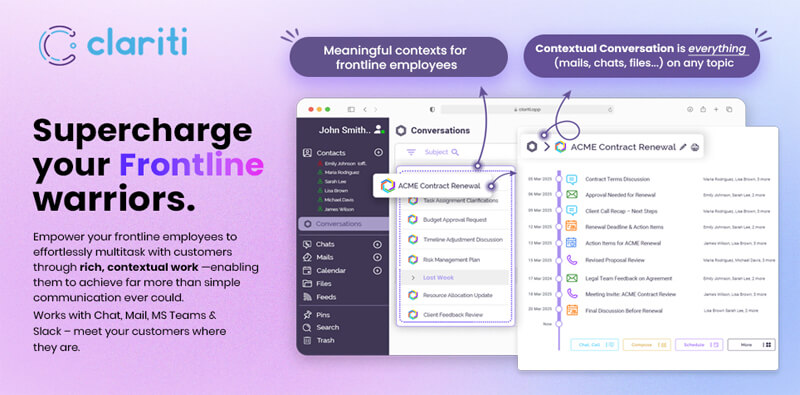
Modern workplaces are flooded with messages across emails, chats, calls, and meetings, making it increasingly difficult to stay organized and consistent in execution. According to a report by Asana, employees switch between apps over 1,100 times a day, leading to scattered communication and missed context. This fragmentation not only wastes time but also breaks the continuity essential for delivering results. That’s where the concept of contextual work becomes critical.
Clariti is built on the foundational belief that consistent work stems from rich, contextual communication. It is architected specifically for companies that need to bridge internal and external workflows, particularly those with frontline employees handling client engagement and backend teams providing support. Frontline workers often receive crucial information from external contacts and must quickly coordinate with internal stakeholders. Clariti enables this by letting them embed external emails directly into topic-based hybrid conversations, providing complete background and history.
At the same time, backend team members—who may not require full email access—can contribute through direct messages, group chats, calls, and screen-sharing, all within the same hybrid conversation. This layered architecture ensures everyone, regardless of role, operates with full clarity and alignment. With Clariti, contextual work isn’t just a productivity concept—it’s a practical reality that aligns communication with action, transforming how modern teams operate. In this blog, we’ll explore why contextual work drives consistency and how Clariti’s design delivers on that promise for every team structure.
10 ways Clariti Proves That Contextual Work is Consistent Work
1. Keeps internal and external communications connected
Clariti is uniquely designed to bridge the gap between frontline employees who engage with clients and backend teams who support them. In most organizations, sales or customer-facing staff handle a constant flow of external emails and queries. With Clariti, they can seamlessly bring those emails into hybrid conversations, enabling real-time discussion with internal teams—without losing context.
Backend teams, who may not interact directly with clients, can still stay informed and contribute effectively through direct messaging, group chats, or screen sharing. When a frontline member embeds an email in a chat, the supporting team gains full insight into the client’s concern without needing to sift through inboxes. This layered communication model ensures that external and internal dialogues remain unified, minimizing confusion and enabling faster, more informed responses. Clariti makes contextual work collaborative and accessible across all levels of the team, regardless of role or communication need.
2. Brings emails, chats, and files into a single hybrid conversation
Clariti eliminates the need to toggle between separate apps or inboxes by merging emails, chats, and files into a unified, topic-based “hybrid conversation.” Imagine your team working on a client proposal—email communications with the client, internal chats discussing the proposal, and related documents like contracts and presentations are all brought together into one hybrid conversation. This seamless structure ensures that everyone involved can access the complete history and context without searching across different platforms or apps.
3. Links calendar events and to-dos directly to conversations
Clariti allows users to create calendar events and to-do items right within the relevant conversation. For example, if your team is planning a product launch, you can set a meeting (calendar event) to review assets and add a to-do to finalize the pricing sheet—both linked within the ongoing conversation about the launch. This ensures actionable items and schedules never get disconnected from the larger context of discussion, helping teams stay organized and accountable.
4. Embeds emails within chats to maintain context
Instead of forwarding emails or summarizing them in chat, Clariti lets you embed an actual email into a hybrid conversation. Suppose a customer support agent receives a complex issue via email; they can embed that email directly into the support team’s chat. This allows the team to respond with full context, reducing misunderstandings and avoiding repetitive clarifications. It also cuts down on unnecessary email chains, keeping responses faster and clearer.
5. Automatically suggests the right conversation
Clariti uses AI to analyze incoming messages and emails and intelligently recommends the most relevant existing conversation to place them in. For instance, if you receive an email from a client about a current marketing campaign, Clariti will suggest adding it to the existing hybrid conversation about that campaign. This saves time and ensures that no message is misplaced, helping teams retain continuity and easily trace the full communication history around a topic.
6. Eliminates app-switching by unifying communication tools
Instead of relying on separate tools for emails, chats, file storage, to-dos, video / voice calling and scheduling, Clariti integrates all these functions in one place. For example, a team member working on a client onboarding project doesn’t need to jump between Gmail, Slack, Google Drive, and a calendar app. With Clariti, they can handle email, chat with teammates, view or share files, and schedule meetings all in one interface—boosting focus and minimizing wasted time due to context switching.
7. Tracks “who said what, when, and why” across all channels
Clariti automatically captures every interaction—email, chat, file share, calendar event—and organizes them chronologically within a hybrid conversation. For example, if your team is discussing a contract revision, you can easily trace who raised a concern (who), the specific message or file (what), when it was said (timestamp), and the context surrounding the decision (why). This level of traceability reduces miscommunication and makes follow-ups more efficient.
8. Allows starting new conversations from any communication
Clariti gives users the flexibility to spin off a new hybrid conversation from an existing message—be it an email, chat, or shared file. Suppose you receive an email with a new client request unrelated to your current conversation. Instead of letting it clutter the ongoing conversation, you can create a new, focused conversation from that email, keeping topics neatly separated while retaining context.
9. Supports asynchronous collaboration without loss of context
Clariti is designed to work seamlessly across time zones and work schedules. A team member in India can add a document and comments to a conversation, and a colleague in the U.S. can pick up right from where they left off—without the need for real-time coordination. Since all communication is preserved in context, there’s no need to repeat discussions or re-explain topics for others who come online later.
10. Provides a searchable history of all communications by topic
Every Clariti hybrid conversation is fully indexed and searchable. If you need to revisit a past discussion on pricing strategy from two months ago, just search by the topic, and you’ll get the entire context—including chats, emails, files, and meeting notes. This eliminates the hassle of digging through inboxes or chat logs and helps teams retrieve vital information in seconds.
Case Study: Enabling Contextual Workflows with Clariti for Seamless Frontline-Backend Collaboration
Background A mid-sized B2C services company with distributed teams across sales, support, and operations faced growing inefficiencies in communication. The frontline team engaged with clients primarily over email, while internal coordination happened through chat apps, video calls, and file-sharing platforms. Fragmented tools led to delayed responses, lost context, and confusion between client-facing employees and backend support teams.
Challenges
- Frontline employees had to constantly switch between email platforms and chat tools to brief backend teams.
- Backend staff lacked visibility into external communications, relying on summaries or forwards.
- Information was often siloed and scattered, leading to missed deadlines, duplications, and errors.
- No centralized place to track the entire lifecycle of a client interaction or project.
Clariti as the Solution
Clariti was deployed with the goal of enabling rich, contextual work tailored to the company’s structure. The solution was ideal because it aligned with their bifurcated team model:
1. For Frontline Teams:
- Frontline employees used Clariti to embed client emails directly into hybrid conversations.
- These hybrid conversations included follow-up chats, shared documents, and scheduled events—all organized by topic.
- They could provide the backend teams with full visibility into the original emails without requiring them to access the inbox.
2. For Backend Teams:
- Backend employees participated through direct messaging, group chats, voice calls, and screen sharing.
- They could respond with full context when frontline teams shared emails or documents.
- Without needing access to every tool, they remained aligned with ongoing client matters.
Results
- Communication gaps between external-facing and internal teams were reduced by over 60%.
- Average response time to client queries dropped by 35%, owing to immediate contextual clarity.
- Onboarding new employees improved, as past hybrid conversations offered a complete history of interactions.
- Overall collaboration became seamless, eliminating the “lost in translation” problem.
Contextual work drives consistent results
Clariti’s contextual conversations made it the perfect fit for this company’s needs. By supporting hybrid communication structures, it empowered frontline employees to carry external conversations into internal collaboration without losing meaning. Backend teams contributed effectively using lightweight tools like chat, calls, and file-sharing—all within Clariti’s centralized environment. The outcome was a workplace where contextual work drove consistent results, improving both efficiency and client satisfaction.
Conclusion
Contextual work is no longer a luxury—it’s essential for achieving clarity and consistency across business communication. Clariti makes this possible by unifying emails, chats, calls, files, and tasks into a single, topic-based view. But what truly sets Clariti apart is its adaptability to the unique needs of both frontline and backend teams. Frontline employees—those handling sales, support, and client communication—benefit immensely from Clariti’s ability to embed external emails directly into internal chat conversations, preserving context while engaging the right people. Meanwhile, backend team members can stay aligned through subject-based group chats, calls, or screen shares, without needing full access to every detail. This seamless collaboration bridge ensures that information flows intelligently across roles, reducing miscommunication and accelerating decision-making.
With Clariti, contextual work becomes second nature—making team interactions more organized, consistent, and outcome-driven. It’s a unified platform built not just for communication, but for clarity at every level of the organization.



Start for FREE with Personal CRM
We too hate spam! Your email is secure with us.

Spot secured. You're in.
You’re officially on the list for early access to Clariti.


No more switching tools.

No more lost context.

Just Clarity.
You’ll be among the first to experience it when we launch. We’ll let you know the moment it’s ready.

Keep an eye out for emails from @clariti.app.
(and check your spam folder just in case—whitelisting us helps ensure you don’t miss a thing).