In a mid-sized logistics company with a large frontline workforce, internal communication had become a growing concern. With over 70% of their employees working outside traditional office settings—on the warehouse floor, in transit, or at remote distribution hubs—the company struggled to keep deskless workers informed and aligned.
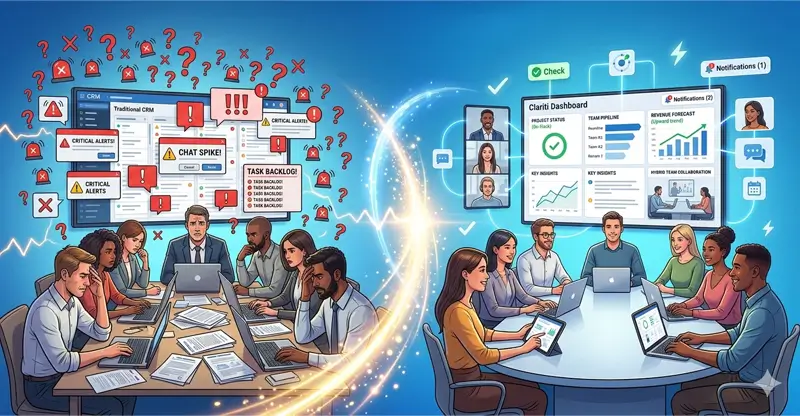
Important updates were frequently missed, follow-ups were scattered across emails and messaging apps, and managers spent hours each week clarifying information or repeating instructions. The reliance on multiple disconnected tools led to fragmentation, delayed decision-making, and operational inefficiencies.
Studies show that nearly 80% of deskless workers feel they are not properly connected to their company’s internal communications, and this organization was no exception.
The leadership team realized that traditional communication tools were simply not built to support the dynamic, mobile nature of their deskless teams. What they needed was a solution that could streamline all interactions—emails, chats, voice calls, shared files, and calendar events—into a single, cohesive flow of communication. That’s when they introduced Clariti, a connected communication platform designed to integrate context and continuity across all formats of interaction.
What followed was a noticeable shift in how information flowed across teams. In the sections that follow, we’ll dive into a conversation between the Team Lead and the Manager to understand exactly how Clariti helped transform their internal communication practices—solving long-standing issues and making everyday collaboration more efficient, contextual, and inclusive for their deskless workforce.
10 ways Clariti is transforming internal communication for deskless teams.
Team Lead: “When we started rethinking how to improve communication with our deskless teams, we knew the traditional email-chat combo wasn’t enough. That’s when we explored Clariti, and the way it transforms communication has been eye-opening. Let me walk you through how it’s helped us.”
Centralizes Emails, Chats, and Files into Unified Hybrid Conversations
Team Lead: “One of our biggest pain points was managing fragmented communication. Our supervisors would send emails, reply in chat apps, and share files separately. Clariti changed that. Now, all these elements—emails, chats, files—are automatically tied together in a single, hybrid conversation.”
Manager: “That must make it easier to track what’s going on.”
Team Lead: “Exactly. For instance, a delivery issue raised via email gets discussed in chat and resolved by sharing a document—all in one place.”
Embeds Emails Directly into Chat for Better Context Sharing
Team Lead: “Clariti lets us embed emails into chats. So instead of saying ‘Check the email I sent,’ we just drop it right into the conversation. Everyone sees the same content with full context.”
Manager: “That’s useful—especially for field workers who don’t have time to switch between apps.”
Reduces Dependency on Multiple Disconnected Tools
Team Lead: “Before Clariti, we juggled five different tools—email clients, messaging apps, file sharing, video conferencing, and calendars. Now we do all of that in Clariti. Fewer tools, less training, and more focus.”
Manager: “Sounds like it reduces cognitive load too.”
Team Lead: “Absolutely. Studies show that 69% of workers waste up to an hour a day switching between apps.”
Enables Voice Calling and Screen Sharing Without Switching Apps
Team Lead: “When someone in the warehouse had a technical question, we used to jump on a separate call app. Now, we just start a voice call in Clariti or share our screen on the spot.”
Manager: “That’s seamless. No extra links, no confusion.”
Organizes Communication by Topic, Not Just by Sender or Channel
Team Lead: “Clariti’s topic-based organization is a game-changer. Instead of hunting through inboxes or chat histories, we follow conversations grouped by subject—‘Inventory Shortages,’ ‘Shift Updates,’ ‘Customer Complaints’—whatever’s relevant.”
Manager: “That makes the communication searchable and actionable.”
Minimizes Information Loss by Preserving Conversation History
Team Lead: “One thing that hurt us in the past was losing track of who said what. Clariti keeps a full history of each conversation, including linked emails, chats, and files.”
Manager: “That must help when new team members join mid-project.”
Team Lead: “It does. They just review the conversation history and get up to speed.”
Supports Real-Time and Asynchronous Communication Equally Well
Team Lead: “Our field workers don’t work standard hours. Some check messages during breaks or after shifts. Clariti supports both real-time and async communication, so no one’s left out.”
Manager: “So people aren’t pressured to respond instantly but can still stay updated?”
Team Lead: “Exactly. It respects everyone’s time.”
Enhances Collaboration with Shared Documents and Calendar Events
Team Lead: “We use shared documents and calendar events within Clariti to coordinate inspections, inventory checks, and training sessions. No more scattered invites or missed updates.”
Manager: “That’s crucial for remote and rotating teams.”
Integrates with 5000+ Apps via Zapier for Workflow Automation
Team Lead: “Another big win is Clariti’s integration with over 5000 apps via Zapier. We automated report sharing from our inventory system to Clariti conversations. No manual updates needed.”
Manager: “So the system feeds updates right into the conversation?”
Team Lead: “Yes, automatically. It saves hours of repetitive work.”
Automatically Links Related Communications to Maintain Full Context
Team Lead: “Finally, Clariti’s AI links related emails, chats, and files so the full conversation thread is preserved—even when multiple people contribute at different times.”
Manager: “That’s helpful when a decision needs to be audited or revisited later.”
Team Lead: “Absolutely. It’s like having a built-in knowledge base for every topic.”
Manager: “This is impressive. It’s clear that Clariti isn’t just another messaging app—it’s solving real communication challenges for deskless teams.”
Team Lead: “Exactly. It brings structure, continuity, and simplicity where it’s most needed.”
Conclusion
Implementing Clariti brought about a significant shift in how internal communication was managed across the organization, particularly for deskless workers who had previously remained disconnected from mainstream updates and collaborative discussions.
By unifying emails, chats, voice calls, files, and calendar events into topic-based hybrid conversations, Clariti eliminated the fragmentation caused by using multiple disconnected tools. Employees no longer had to toggle between platforms to access relevant information; everything was contextual, organized, and available in one place. This improved visibility and alignment across departments, reduced miscommunication, and saved valuable time spent on repetitive clarifications and follow-ups.
Moreover, the ability to embed emails directly into chat messages, preserve complete conversation histories, and link related communications automatically ensured that no critical detail was lost or overlooked—especially useful for shift-based and field employees who accessed updates asynchronously.
Managers reported improved responsiveness from their teams and fewer delays in routine workflows, while frontline staff expressed greater confidence in staying informed and contributing meaningfully, despite not having constant access to a desktop environment.
The key takeaway from the organization’s adoption of Clariti was clear: effective internal communication does not require more tools, but smarter, more connected ones. Clariti helped bridge the communication gap between desk-based and deskless teams by providing a single, integrated platform that supported real-time and asynchronous communication equally well. As a result, the organization not only improved productivity and team cohesion but also laid the foundation for more inclusive and scalable communication practices going forward.