

Blog
Frontline Employees: Definition, Challenges, and Why They’re the Backbone of Every Business
- By Priya Saravanan
- No Comments


- Published on
- 10 min read

Blog Summary
Frontline employees with the 80% of workers not behind desks are the backbone of retail, healthcare, logistics, hospitality, and manufacturing. They interact with customers, operate equipment, fulfill orders, and deliver care. Yet they're often the least connected to corporate systems and the most likely to feel overlooked.
Common challenges:
- Communication gaps with leadership
- Limited access to technology
- High burnout and turnover (60–100% annually in some sectors)
- Minimal training and unclear career paths
Proven solutions like Mobile-first communication tools, real-time recognition programs, microlearning and on-demand training, clear goals and empowered managers, technology that reduces friction could fix these mentioned challenges.
Organizations investing in frontline experience see 15–30% lower turnover, 20% higher sales, and measurably better customer satisfaction.
Frontline success is business success. The question is whether you'll invest before your competitors do.
View more
Walk into any retail store, hospital, warehouse, or hotel, and the first people you encounter are frontline employees. They greet customers, solve problems on the spot, fulfill orders, deliver care, and keep operations running smoothly. Yet despite their critical role, frontline workers are often the least connected to corporate systems, the last to receive important updates, and the first to feel the strain when communication breaks down.
In 2026, frontline employees represent approximately 80% of the global workforce of roughly 2.7 billion people. They don’t work behind desks. They work on floors, in fields, on routes, and at counters. And increasingly, businesses are realizing that investing in frontline success isn’t optional; it’s essential to competitiveness, customer satisfaction, and growth.
This guide explores who frontline employees are, the unique challenges they face, why they matter more than ever, and how organizations can better support, communicate with, and retain this vital workforce.
What Are Frontline Employees
Definition of Frontline Employees
Frontline employees are workers who interact directly with customers, handle physical products or services, or operate essential equipment in real-time environments. They are the “front line” between a company and its customers, or between a company and its core operational output.
Unlike office-based knowledge workers, frontline employees typically:
- Work in shifts rather than fixed 9-to-5 schedules
- Spend little to no time at a desk or computer
- Interact with customers, patients, equipment, or inventory throughout their day
- Rely on mobile devices, radios, or in-person communication rather than email
- Face immediate, real-world consequences when information is missing or unclear
Frontline Employees vs. Desk Workers - Key Differences
The distinction between frontline and desk workers shapes how organizations must communicate, train, and support each group.
|
Aspect
|
Frontline Employees
|
Desk Workers
|
|---|---|---|
|
Primary work location
|
Store floors, warehouses, patient rooms, field sites
|
Offices, remote desks
|
|
Technology access
|
Limited or mobile-only
|
Full desktop and email access
|
|
Communication style
|
Real-time, verbal, mobile
|
Email, chat, scheduled meetings
|
|
Schedule type
|
Shifts, weekends, irregular hours
|
Standard business hours
|
|
Decision-making
|
Immediate, on-the-spot
|
More time for research and deliberation
|
|
Visibility to leadership
|
Often low
|
Often high
|
These differences mean that tools, policies, and communication practices designed for desk workers often fail spectacularly when applied to frontline teams.
Where Do Frontline Employees Work (Industries Overview)
Frontline workers span nearly every sector of the economy:
- Retail: cashiers, sales associates, stockroom workers
- Healthcare: nurses, medical assistants, lab techs, home health aides
- Logistics: warehouse pickers, delivery drivers, dock workers
- Hospitality: hotel staff, servers, kitchen workers, concierges
- Manufacturing: assembly line workers, quality control inspectors
- Transportation: bus drivers, airline crew, transit operators
- Field services: maintenance technicians, installers, repair specialists
- Education: teaching assistants, cafeteria staff, campus security
- Government services: postal workers, sanitation crews, emergency responders
In nearly every case, these employees are the operational engine and customer-facing identity of their organizations.
Types of Frontline Employees
Retail & Customer Service Workers
Retail frontline workers manage inventory, assist customers, process transactions, and handle returns or complaints. Their effectiveness directly impacts sales, brand perception, and repeat business. Yet they often work with outdated systems, unclear return policies, and inconsistent communication from headquarters.
Healthcare & Medical Staff
Nurses, CNAs, medical assistants, and support staff deliver patient care under high-pressure conditions. They work in shifts, handle emergencies, and must stay current on protocols, medications, and safety standards. Communication delays in healthcare settings can have life-or-death consequences.
Logistics, Warehouse & Delivery Workers
These workers pick, pack, load, transport, and deliver products. They work in physically demanding environments, often with tight productivity targets. Real-time visibility into route changes, inventory updates, and delivery exceptions is critical to their success.
Hospitality & Food Service Employees
Hotel staff, restaurant servers, kitchen workers, and event coordinators manage guest experiences in real time. They juggle special requests, dietary restrictions, last-minute changes, and service recovery all while maintaining warmth and professionalism under pressure.
Manufacturing & Factory Floor Workers
Assembly line workers, machine operators, and quality inspectors keep production running. They need immediate access to work instructions, safety alerts, quality standards, and shift handoff notes. Downtime due to miscommunication costs thousands of dollars per hour.
Field Service & Maintenance Technicians
HVAC techs, electricians, telecom installers, and repair workers travel to customer sites. They need mobile access to work orders, parts availability, customer history, and troubleshooting guides. Poor information flow results in repeat visits, wasted time, and frustrated customers.
Why Frontline Employees Are Critical to Business Success
They Are the Face of Your Brand
For most customers, the brand is the person they interact with. A helpful retail associate, a compassionate nurse, a professional delivery driver these interactions shape brand perception far more than any marketing campaign. Frontline employees embody your values in real time, for better or worse.
Direct Impact on Customer Experience
Customer satisfaction scores correlate strongly with frontline employee engagement. When frontline workers feel informed, supported, and valued, they deliver better service. When they feel disconnected or unsupported, service quality suffers visibly.
Research by Gallup shows that highly engaged teams see 10% higher customer ratings and 20% higher sales compared to disengaged teams. For frontline-heavy industries, this difference translates directly to revenue and retention.
Revenue Generation at the Point of Sale
Frontline employees don’t just support the business they often are the business. Retail associates upsell. Servers recommend high-margin items. Technicians identify additional service opportunities. Their product knowledge, communication skills, and engagement directly drive top-line growth.
The Cost of Losing Frontline Talent
Frontline turnover is expensive. The cost to replace a single frontline worker typically ranges from 50% to 200% of their annual salary when factoring in recruiting, onboarding, training, lost productivity, and service disruption.
High turnover also creates a vicious cycle: remaining employees face heavier workloads, service quality drops, customer complaints rise, and morale deteriorates further. Organizations that reduce frontline turnover by even 10% see measurable improvements in customer satisfaction and profitability.
Common Challenges Faced by Frontline Employees
Communication Gaps with Management
Frontline workers frequently report feeling disconnected from leadership and decision-making. Corporate announcements arrive late, are buried in email they rarely check, or are filtered inconsistently through multiple management layers. By the time critical information reaches the floor, it’s often outdated or misunderstood.
Lack of Access to Technology & Tools
Many frontline employees lack company email addresses, desktop access, or time during shifts to check digital platforms. Communication tools designed for desk workers like lengthy email threads or scheduled Zoom meetings simply don’t work for people constantly moving, serving customers, or operating equipment.
High Burnout and Turnover Rates
Frontline work is physically demanding, emotionally taxing, and often underappreciated. Employees work weekends, holidays, and irregular shifts. They absorb customer frustration, handle emergencies, and adapt to last-minute changes with little recognition. Burnout rates in healthcare, retail, and hospitality consistently exceed those in desk-based roles.
Limited Training & Career Growth Opportunities
Frontline workers often receive minimal onboarding sometimes just a few hours of shadowing before they’re expected to perform independently. Ongoing training is sporadic, and career advancement paths are unclear. Without visible growth opportunities, talented frontline employees leave for employers who invest in development.
Feeling Undervalued or Overlooked
Despite their critical role, frontline employees frequently feel invisible to senior leadership. Their feedback rarely reaches decision-makers. Their daily challenges go unnoticed. Recognition programs, when they exist, often feel generic or disconnected from the real work being done.
How to Effectively Manage Frontline Employees
Building a Culture of Recognition
Recognition matters deeply to frontline workers, especially when it’s specific, timely, and public. Effective recognition programs:
- Celebrate specific behaviors and outcomes, not just tenure
- Come from peers and managers, not just corporate headquarters
- Happen frequently in small doses rather than annually in large batches
- Connect individual contributions to team and organizational success
Simple practices like shift-end shout-outs, peer-nominated awards, and manager thank-you notes create meaningful impact at low cost.
Real-Time Communication Strategies
Frontline employees need information fast, in formats they can consume between tasks. Effective communication strategies include:
- Short, visual updates (videos, infographics, photos)
- Mobile-first platforms accessible on personal or company devices
- Push notifications for urgent updates
- Shift huddles for context and Q&A
- Centralized repositories for policies, procedures, and FAQs
Email-heavy communication fails frontline teams. Real-time, mobile-accessible platforms succeed.
Setting Clear Goals and Expectations
Frontline employees perform best when they understand what success looks like and how their work contributes to larger goals. Effective goal-setting includes:
- Clear, measurable performance standards
- Real-time feedback on progress
- Transparent connection between individual tasks and business outcomes
- Regular calibration to ensure fairness and achievability
When expectations are vague or constantly shifting, engagement plummets.
Empowering Frontline Managers
Frontline managers shift supervisors, team leads, floor managers are the critical link between corporate strategy and daily execution. Yet they’re often undertrained, under-resourced, and overwhelmed. Empowering frontline managers means:
- Providing leadership training, not just technical training
- Giving them authority to make decisions and solve problems locally
- Equipping them with tools to track performance and give feedback
- Reducing administrative burden so they can focus on their teams
Strong frontline managers multiply the effectiveness of everyone they lead.
Training & Development for Frontline Employees
Onboarding Best Practices
Effective frontline onboarding balances speed with thoroughness. Best practices include:
- Role shadowing with structured observation checklists
- Hands-on practice in low-stakes environments
- Short video modules covering policies, safety, and systems
- Clear milestones and checkpoints before independent work
- Buddy systems pairing new hires with experienced peers
Poor onboarding leads to early turnover, safety incidents, and service failures. Investing upfront pays dividends quickly.
Microlearning and Mobile-Friendly Training
Frontline workers can’t spend hours in classroom training. Microlearning short, focused lessons delivered digitally fits their reality. Effective microlearning:
- Delivers content in 3–5-minute modules
- Uses video, quizzes, and interactive elements
- Is accessible on mobile devices during breaks or downtime
- Focuses on one skill or concept per module
- Allows self-paced progress with progress tracking
Platforms like Axonify, Lessonly, and others specialize in frontline-friendly microlearning.
Upskilling vs. Reskilling - What Frontline Teams Need
Upskilling means building on existing skills to improve performance or prepare for advancement—teaching a retail associate advanced selling techniques or inventory management.
Reskilling means learning entirely new skills for different roles training a warehouse worker for a logistics coordinator position.
Frontline teams need both. Upskilling drives engagement and performance in current roles. Reskilling creates visible career pathways that reduce turnover.
Using Technology for Continuous Learning
Technology enables ongoing development at scale. Effective approaches include:
- Learning management systems (LMS) with mobile access
- On-demand video libraries for reference and reinforcement
- Gamification and leaderboards to drive participation
- Integration with performance data to personalize learning paths
- Manager dashboards showing team completion and skill gaps
When learning is easy, relevant, and recognized, frontline employees engage willingly.
Technology & Tools for Frontline Employees
Mobile-First Communication Platforms
Frontline communication requires platforms designed for smartphones, not desktops. Key features include:
- Push notifications for urgent updates
- Group messaging for teams and shifts
- Document libraries accessible on mobile
- Video messaging for richer communication
- Read receipts and engagement analytics
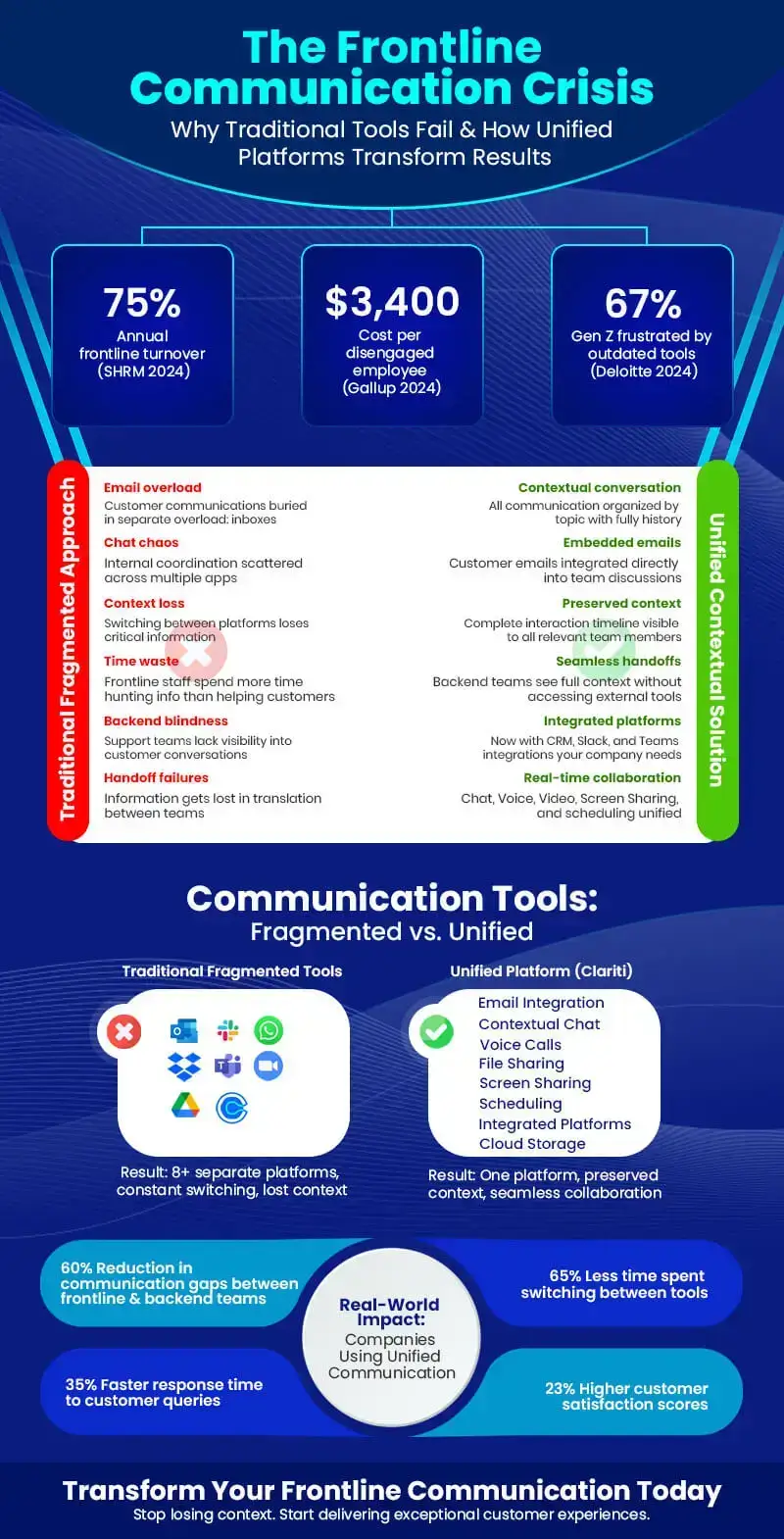
Platforms like Beekeeper, Zinc, Crew, and WorkJam specialize in frontline communication. For teams needing integrated task management alongside communication, solutions like Clariti can help by keeping conversations, tasks, files, and updates organized in context rather than scattered across disconnected tools.
Workforce Management Software
Workforce management (WFM) tools help schedule shifts, track time, manage requests, and ensure compliance. Leading platforms include:
- Shift scheduling with employee self-service and swap capabilities
- Time and attendance tracking with mobile clock-in/out
- Labor forecasting based on demand patterns
- Compliance monitoring for breaks, overtime, and labor laws
When scheduling is transparent and flexible, employee satisfaction improves measurably.
AI-Powered Tools for Frontline Productivity
Artificial intelligence is increasingly supporting frontline work through:
- Predictive scheduling that matches staffing to forecasted demand
- Intelligent task prioritization based on urgency and capacity
- Chatbots answering common employee questions instantly
- Real-time translation for multilingual teams
- Safety monitoring using computer vision
AI won’t replace frontline workers, but it can reduce friction and administrative burden.
Digital Shift Scheduling & Task Management
Beyond basic WFM, specialized tools help frontline teams coordinate daily work:
- Digital checklists ensuring consistent task completion
- Shift handoff tools capturing critical context between teams
- Issue reporting and escalation workflows
- Integrated task assignment and status tracking
For teams where tasks are closely tied to ongoing conversations such as coordinating client requests, managing service calls, or handling operational issues platforms that unify communication and task management in one view reduce the need to switch between multiple apps. This is where tools like Clariti offer value by organizing work contextually rather than forcing team members to reconstruct information from fragmented sources.
Frontline Employee Statistics You Should Know in 2026
Global Workforce Data
- Frontline workers represent approximately 80% of the global workforce roughly 2.7 billion people.
- In the United States alone, frontline employees number over 100 million workers.
- Industries with the highest concentrations of frontline workers include retail, healthcare, manufacturing, logistics, and hospitality.
Engagement and Turnover Benchmarks
- Frontline employee engagement scores average 15–20 points lower than desk-based employees across most industries.
- Annual turnover rates for frontline roles range from 60% in retail to 100%+ in food service and hospitality.
- The cost to replace a single frontline employee typically ranges from $3,000 to $7,000 depending on role complexity.
- Organizations in the top quartile for frontline engagement see 25% higher profitability than those in the bottom quartile.
Investment Trends in Frontline Technology
- Global spending on frontline worker technology is projected to exceed $14 billion annually by 2027.
- Mobile-first communication platforms have seen 200%+ adoption growth since 2020.
- Companies investing in frontline digital tools report 15–30% reductions in turnover within the first year.
- AI-powered workforce management tools are expected to reach 40% adoption among large employers by 2028.
These numbers underscore a clear trend: organizations that invest strategically in frontline employee experience gain measurable competitive advantages.
Conclusion
Frontline employees are not an operational afterthought; they are the operational core. They generate revenue, shape brand perception, deliver customer experiences, and determine whether strategies succeed or fail in practice. Yet they remain the workforce segment least likely to feel connected, informed, or valued.
The organizations winning in 2026 understand this disconnect and are addressing it deliberately through better communication tools, mobile-first technology, meaningful recognition, clear career pathways, and leadership that treats frontline success as a strategic priority rather than a human resources checkbox.
The changes required are not complicated: give frontline workers the information they need when they need it, in formats they can actually use. Recognize their contributions specifically and often. Invest in their development and create visible paths forward. Equip their managers to lead effectively. Use technology that reduces friction rather than adding it.
When frontline employees succeed, businesses succeed. The correlation is direct, measurable, and undeniable. The question is not whether to invest in frontline experience; it’s whether you’ll do it before or after your competitors do.
Frequently Asked Questions
What is a frontline employee?
A frontline employee is a worker who interacts directly with customers, handles physical products or services, or operates essential equipment in real-time operational environments. They typically work in shifts rather than standard office hours and have limited access to desk-based technology.
What is the difference between frontline and non-frontline employees?
Frontline employees work in customer-facing or operationally critical roles with limited desk access, while non-frontline (or “deskless”) employees work primarily in offices with full access to computers, email, and corporate systems. Frontline workers rely on mobile tools, verbal communication, and real-time decision-making, whereas desk workers typically have more time for research and asynchronous collaboration.
Why are frontline employees important to a business?
Frontline employees are the primary driver of customer experience, brand perception, and revenue generation in most industries. They interact directly with customers, fulfill orders, deliver services, and operate core business processes. Their engagement and effectiveness directly correlate with customer satisfaction, sales performance, and operational efficiency.
What industries have the most frontline employees?
The industries with the highest concentrations of frontline workers include retail, healthcare, manufacturing, logistics and warehousing, hospitality and food service, transportation, field services, education support, and government services. Combined, these sectors employ the majority of the global workforce.
What are the biggest challenges frontline employees face?
The most common challenges include communication gaps with management, limited access to technology and information, high rates of burnout due to demanding schedules, lack of training and career development opportunities, and feeling undervalued or invisible to leadership despite their critical role.
How can companies improve frontline employee engagement?
Effective strategies include implementing mobile-first communication tools, providing timely and specific recognition, offering clear career pathways and development opportunities, empowering frontline managers with training and authority, reducing administrative burden through automation, and creating feedback loops that ensure frontline voices reach decision-makers.
How do you train frontline employees effectively?
Effective frontline training uses mobile-friendly microlearning modules, hands-on practice with structured shadowing, visual and video-based content that’s easy to consume quickly, just-in-time reference materials accessible during work, and clear performance milestones with regular feedback. Training should be brief, specific, practical, and accessible on the devices frontline workers actually use.
What technology tools help frontline employees?
Key technology categories include mobile-first communication platforms for real-time updates, workforce management software for scheduling and time tracking, task management and digital checklists, learning management systems with mobile access, AI-powered chatbots for instant answers, and integrated platforms that combine communication with task tracking to reduce app-switching and information fragmentation.
Why is frontline employee turnover so high?
High turnover stems from demanding physical work, irregular and often inconvenient schedules, emotional stress from customer interactions, limited recognition and career growth, communication disconnects with management, inadequate training, and compensation that often doesn’t match the difficulty and importance of the work. When employees feel undervalued and see no path forward, they leave.
What do frontline employees need most from their employers?
Frontline workers consistently report needing clear, timely communication; access to the information required to do their jobs well; recognition for their contributions; opportunities to learn and advance; fair and predictable scheduling; managers who support and advocate for them; and the sense that leadership understands and values their work. Meeting these needs reduces turnover and drives engagement measurably.


Start for FREE with Personal CRM
We too hate spam! Your email is secure with us.

Spot secured. You're in.
You’re officially on the list for early access to Clariti.


No more switching tools.

No more lost context.

Just Clarity.
You’ll be among the first to experience it when we launch. We’ll let you know the moment it’s ready.

Keep an eye out for emails from @clariti.app.
(and check your spam folder just in case—whitelisting us helps ensure you don’t miss a thing).