
Communication Concepts for Modern Teams
Clear communication starts with shared understanding. These concepts explain how context, topics, and AI-powered conversations help teams communicate with clarity, continuity, and purpose-across chats, emails, meetings, and files.
What Are Meaningful Conversations?
Definition, Importance & Examples
Meaningful conversations in the workplace are structured discussions where messages retain context, purpose, and continuity over time. Rather than isolated exchanges, meaningful conversations connect related interactions into coherent dialogue that supports decision-making and knowledge building.
In modern organizations, meaningful conversations reduce ambiguity, strengthen collaboration, and transform communication from reactive messaging into structured understanding.
Why Many Workplace Conversations Lack Meaning
Workplace communication often prioritizes speed over structure. As message volume increases, conversations may become:
- Fragmented across tools.
- Detached from their original purpose.
- Disconnected from prior decisions.
- Reduced to short, reactive responses.
When context and continuity are lost, communication shifts from constructive dialogue to transactional exchanges.
Meaningful conversations address this by preserving clarity and intent.
What Makes a Conversation Meaningful?
A meaningful workplace conversation typically includes:
- A clearly defined subject.
- Preserved background context.
- Traceable decisions and rationale.
- Logical progression over time.
- Participation transparency.
Meaning is not created by message length or frequency, but by structural continuity and relevance.
Meaningful Conversations vs Message Exchanges
Message exchanges focus on delivery. They prioritize speed and immediate response.
Meaningful conversations prioritize:
- Subject continuity.
- Decision clarity.
- Context preservation.
- Logical sequencing.
While messages may be brief, their connection to a structured conversation ensures they retain purpose and significance.
Meaningful Conversations in Practice
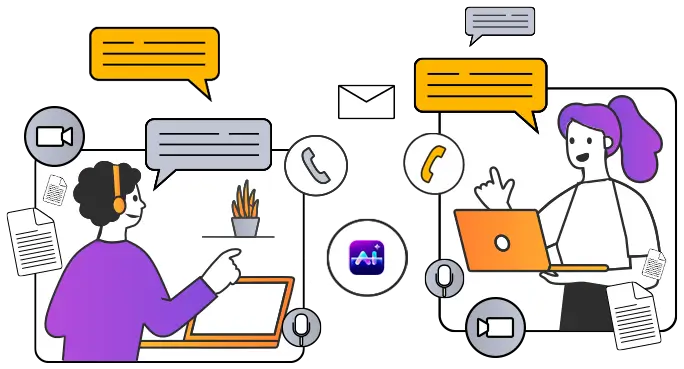
A practical implementation of meaningful conversations can be observed in platforms such as Clariti. By connecting related emails, chat discussions, files, and meetings within unified, topic-based conversations, Clariti preserves the full context behind each subject. This structure ensures that discussions remain coherent and interpretable as they evolve.
How Structure Enables Meaning
Meaningful conversations depend on structural elements such as:
- Topic-based organization.
- Integrated communication formats.
- Chronological continuity.
- Context visibility.
- Decision documentation.
When these elements are embedded into communication systems, participants can understand not only what was said, but why it matters.
The Role of AI in Supporting Meaningful Conversations
Artificial intelligence strengthens meaningful conversations by:
- Detecting subject relationships across channels.
- Associating new interactions with relevant discussions.
- Preserving chronological and contextual integrity.
- Reducing noise and irrelevant message volume.
AI does not create meaning independently; it supports the preservation of meaning by maintaining structural continuity.
Meaningful Conversations in Asynchronous Work
In distributed environments, conversations often span extended timeframes. Without preserved context, meaning erodes as participants rotate or delays occur.
Meaningful conversations allow team members to:
- Re-enter discussions with full background.
- Review prior decisions.
- Identify dependencies.
- Continue dialogue without repeated clarification.
This supports clarity in remote and hybrid workplaces.
Impact on Productivity and Collaboration Quality
When conversations remain meaningful:
- Decision traceability improves.
- Redundant communication decreases.
- Onboarding into discussions accelerates.
- Misinterpretation risk declines.
Over time, structured dialogue enhances collaboration quality and strengthens organizational memory.
How Meaning Compounds Over Time
Each preserved interaction adds depth to a conversation. Long-running discussions accumulate insights, rationale, and documentation.
Instead of restarting discussions, teams build upon existing understanding. This compounding effect converts communication into a durable knowledge asset.
Common Misconceptions About Meaningful Conversations
Meaningful conversations are not:
- Longer conversations.
- More formal communication.
- Increased documentation requirements.
- Slower response cycles.
They are structurally coherent exchanges that maintain relevance and continuity.
Practical Examples
Customer support teams maintain meaningful conversations by connecting customer inquiries, internal discussions, and resolution updates within one structured subject.
Product teams build meaningful conversations by linking design revisions, stakeholder feedback, and approval decisions.
Sales teams preserve negotiation history, stakeholder input, and documentation within one evolving dialogue.
In each case, preserved context strengthens clarity and outcomes.
Closing Perspective
Meaningful conversations address a fundamental challenge in modern work: ensuring that communication retains clarity and purpose as it becomes faster and more distributed. By preserving context, subject continuity, and decision rationale, organizations transform fragmented messages into coherent dialogue that supports long-term collaboration and knowledge growth.
Frequently Asked Questions
What are meaningful conversations in the workplace?
Meaningful conversations are structured discussions that preserve context, purpose, and continuity over time.
How are meaningful conversations different from chat threads?
Chat threads may preserve replies, but meaningful conversations maintain subject continuity and decision context across formats.
Why are meaningful conversations important for teams?
They reduce ambiguity, prevent repeated explanations, and improve collaboration quality.
How does AI support meaningful conversations?
AI connects related interactions and preserves structural continuity automatically.
Do meaningful conversations require additional documentation?
No. They depend on structural organization rather than increased content volume.

Start for FREE with Personal CRM
We too hate spam! Your email is secure with us.

Spot secured. You're in.


No more switching tools.

No more lost context.

Just Clarity.

Keep an eye out for emails from @clariti.app.
(and check your spam folder just in case—whitelisting us helps ensure you don’t miss a thing).