

Blog
Transform Email Chaos into Seamless Team Collaboration with Clariti
- By Clariti Team
- No Comments

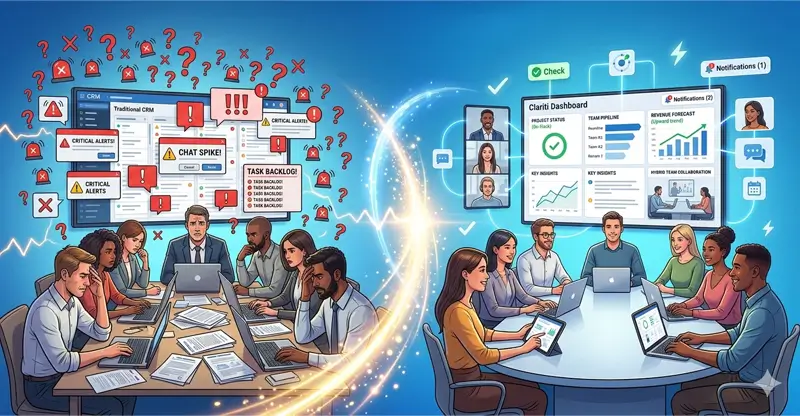
Email overload is a common issue for teams, with studies showing that the average professional receives 121 emails per day. Managing this volume of communication can lead to chaos, confusion, and lost productivity. As teams increasingly rely on email for internal and external communication, vital information often gets buried under endless threads, scattered across various platforms, and missed in the noise. This results in miscommunication, delayed decisions, and time wasted searching for relevant conversations or files. According to McKinsey, employees spend 28% of their workweek managing emails alone, which significantly hampers productivity.
This is where Clariti emerges as a game-changer. Clariti offers a fresh approach by transforming the way teams handle communication. Rather than treating emails, chats, documents, and tasks as separate silos, Clariti integrates them into contextually linked Conversations. This unique feature allows users to track conversations and related files effortlessly, reducing the need to switch between multiple apps or search for information.
With Clariti, everything—from emails to chats and documents—is connected and organized into Conversations based on the topic or project. This ensures that crucial details are never lost, and collaboration happens smoothly. In fact, businesses that have adopted smarter communication solutions like Clariti have reported up to a 20% improvement in team productivity. By turning email chaos into structured collaboration, Clariti is helping teams save time, reduce distractions, and focus on achieving their goals more efficiently.
Email, while essential for external communication, falls short as an effective collaboration tool for internal teams. Here’s why email sucks for internal collaboration and is best left for external communication:
1. Lack of Real-Time Interaction
Emails don’t offer the immediacy that teams need for fast-paced collaboration. Internal discussions often require real-time communication, whether it’s brainstorming ideas, quick problem-solving, or urgent updates. Emails lead to delays, as team members must wait for responses, leading to bottlenecks and slowed decision-making.
2. Endless Threads & Information Overload
Emails result in long, tangled threads that are difficult to follow, especially when multiple people are involved. Important points get buried, and context is often lost in the clutter. For internal communication, this creates confusion and wastes time as team members sift through irrelevant messages to find the right information.
3. Siloed Conversations
Emails are disconnected from other tools used for collaboration, such as chats, document sharing, and task management. This creates silos where related discussions, files, and updates are spread across different platforms, making it difficult to track progress and manage projects efficiently.
4. Overload and Burnout
Research from Adobe reveals that the average worker spends 3.1 hours per day checking work emails, contributing to information overload and reduced productivity. With 70% of employees reporting, they check email even outside of work hours, the constant influx of irrelevant messages significantly increases stress and contributes to burnout.
5. Poor for Team Collaboration Tools
Unlike modern collaboration tools that integrate chats, file sharing, and tasks in one platform, email remains linear and isolated. It lacks the dynamic, interactive features necessary for fast-paced, internal teamwork.
Email: Best for External Communication
Where email excels is in external communication—client relations, formal business exchanges, and structured communication with people outside the organization. It offers a reliable, formal medium to document interactions and exchange information in a professional setting, making it ideal for external outreach, proposals, and customer relations.
For internal collaboration, however, teams need more efficient, real-time solutions like Clariti, which streamline communication and keep everything connected, in context, and organized.
4 ways Clariti turns emails into actionable tasks
1. Imports emails from Gmail and other providers:
Imagine a marketing manager overseeing campaigns for multiple clients. They have separate email accounts for each client, making it challenging to keep track of all the incoming communications. The manager spends significant time toggling between inboxes, searching for important messages, and trying to maintain context across different projects.
Clariti allows users to configure up to 4 email accounts and import emails from various providers, including Gmail, into a unified inbox within the Clariti platform. This means the marketing manager can access all client emails in one central location, streamlining their workflow and ensuring they don’t miss critical information.
The marketing manager connects their Gmail, Outlook, and two client-specific email accounts to Clariti. Now, instead of navigating between different inboxes, they can see all emails related to their campaigns in a single, organized view. This allows them to quickly prioritize tasks, respond to inquiries, and stay on top of project updates without the risk of important messages slipping through the cracks.
2. Share emails in chat for greater context:
The product development team is discussing a new feature request that was received via email from a key client. However, the email contains technical details and context that would be helpful for the entire team to reference as they brainstorm solutions. Sharing the email separately or forwarding it around could lead to confusion and a loss of important information.
Clariti allows users to share emails directly within chat conversations, ensuring that all relevant context is preserved and accessible to the entire team. This eliminates the need for endless email forwarding and helps maintain a clear, consolidated record of the discussion.
The product manager shares the client’s feature request email in the team’s Clariti chat. Now, as the developers discuss potential solutions, they can refer back to the original email, highlighting specific points, and adding their own comments and ideas within the same conversation thread. This keeps the discussion focused, contextual, and reduces the risk of critical details being overlooked or lost.
3. Start conversations from email:
The sales team receives an inquiry from a prospective client, but they need to quickly gather input from the marketing, pricing, and customer service teams before crafting a response. Trying to coordinate this collaboration via email would be cumbersome and slow.
Clariti allows users to start a new chat conversation directly from an email, with or without sharing the email content. This enables teams to quickly engage in real-time discussions and decision-making without leaving the context of the original message.
The sales representative receives the client inquiry email and starts a new Clariti conversation about it. They invite the relevant team members, who can now discuss the client’s needs, suggest pricing options, and coordinate a tailored response – all within the context of the original email. This streamlines the collaboration process and ensures the client receives a timely, well-informed reply.
4. Maintains context for all emails:
The customer support team regularly receives a high volume of emails from clients reporting bugs, requesting features, or asking for assistance. To streamline this process and maintain context, integrating tools like Mail Tester can help ensure email quality and proper issue tracking, making it easier to address each concern effectively.
As these emails accumulate, it becomes increasingly difficult to maintain context and ensure that each issue is addressed effectively. Important details can get lost, leading to frustrated clients and inefficient problem-solving.
Clariti’s machine learning algorithm automatically groups related emails into cohesive conversation threads, preserving the context and history of each issue or request. This prevents emails from becoming isolated and ensures that the support team has a complete understanding of the client’s needs and previous interactions.
A client emails the support team about a bug they’re experiencing with the software. The Clariti ML engine recognizes this email as part of an ongoing conversation and automatically links it to the previous messages the client has sent on the same topic. When the support agent opens the thread, they can immediately see the full context, including any troubleshooting steps already taken, and respond accordingly. This allows the agent to provide a more informed, efficient, and personalized solution, improving the client’s experience.
By integrating these powerful features, Clariti transforms the way teams manage and act on email communications. Instead of drowning in a sea of disconnected messages, users can leverage Clariti to turn emails into organized, actionable tasks that drive productivity and collaboration.
Case Study: How Clariti Transformed Email Chaos into Seamless Collaboration
Clariti client, a mid-sized software development company with 150 employees, specializes in creating custom software solutions for small to medium-sized businesses.
The Challenge
The client was facing severe productivity issues due to email overload:
- Employees spend an average of 2.5 hours daily managing emails.
- Important information was frequently lost or overlooked in long email threads.
- Team collaboration was hindered by siloed communication.
- Project managers struggled to keep track of tasks and deadlines buried in emails.
- Client communication was often delayed due to internal email bottlenecks.
These issues led to missed deadlines, miscommunication with clients, and a general sense of frustration among team members.
The Solution: Implementing Clariti
After researching various productivity tools, our client decided to implement Clariti across their organization. The implementation process took just a few hours, with all employees receiving training on how to use the platform effectively.
Key Clariti Features Utilized
- Email Integration: Clariti allowed employees to import emails from multiple accounts (Gmail, Outlook, etc.) into a unified inbox.
- Context-Based Conversations: Emails could be shared directly in chat conversations, maintaining context and reducing the need for forwarding.
- AI-Powered Organization: Clariti’s machine learning algorithm automatically grouped related emails, chats, and documents into coherent threads.
- Task Creation from Emails: Employees could easily convert emails into actionable tasks within the same platform.
- Real-Time Collaboration: Team members could start instant chat discussions from emails, speeding up decision-making processes.
Implementation Process
- The IT team set up Clariti accounts for all employees and integrated existing email systems.
- Department heads and team leaders received advanced training on Clariti features.
- All employees underwent basic training sessions on using Clariti for daily communication.
- Full transition to Clariti for internal communication and project management.
Results
After three months of using Clariti, our client saw significant improvements:
1. Time Savings:
- Email management time reduced from 2.5 hours to 1 hour per day per employee.
- This translated to a company-wide saving of 225 hours per day or 4,875 hours per month.
2. Improved Project Management:
- Project managers reported a 40% reduction in time spent searching for project-related information.
- Task completion rates increased by 30% due to better organization and visibility.
3. Enhanced Collaboration:
- Cross-departmental collaboration increased by 50%, as measured by joint project initiatives.
- Decision-making speed improved by 35% due to real-time discussions enabled by Clariti.
4. Client Satisfaction:
- Client response times improved by 60%, leading to a 25% increase in positive client feedback.
- Miscommunication incidents with clients decreased by 70%.
5. Employee Satisfaction:
- In an internal survey, 85% of employees reported feeling less stressed about email management.
- 78% said they felt more productive and organized in their daily work.
Specific Use Cases
- Project Kickoff Efficiency: The sales team received a new project request via email. Instead of forwarding it to multiple departments, they shared it in a Clariti chat, tagging relevant team members. This sparked an immediate discussion, allowing them to draft a proposal 40% faster than their previous average time.
- Bug Resolution Speed: When a critical bug report came in, the support team shared it in a dedicated Clariti thread. Developers could see the full context, including previous communications about the issue. This resulted in bug resolution time decreasing by 50%.
- Client Communication Clarity: Account managers used Clariti to maintain clear communication threads with each client. By having all interactions in one place, they could provide more informed and timely responses, leading to a 30% increase in client retention rates.
Game-changer
By implementing Clariti, our client successfully transformed their email chaos into a streamlined, efficient collaboration system. The platform’s ability to integrate emails into a broader context of communication and task management proved instrumental in boosting productivity, improving client relations, and enhancing employee satisfaction.
The success at our client company demonstrates how Clariti can be a game-changer for mid-sized companies struggling with email overload and fragmented communication. By providing a unified platform for context-rich collaboration, Clariti enabled our client to focus more on innovation and less on managing communication channels.
Conclusion
Email overload can severely hamper productivity, causing miscommunication, lost information, and burnout. Clariti offers a comprehensive solution to transform this chaos into streamlined, context-based collaboration. By consolidating emails, chats, documents, and tasks into organized conversations, Clariti reduces the clutter and ensures that all team communication remains focused and relevant. Its unique ability to group related messages and files into topic-based threads allows teams to stay on top of important information without sifting through overwhelming inboxes.
This approach not only saves time but also improves decision-making and efficiency. Clariti helps businesses transition from a disorganized email system to a more cohesive, collaborative work environment where everyone can stay aligned and engaged. Ultimately, it fosters seamless communication, reduces distractions, and enhances overall team productivity.



Start for FREE with Personal CRM
We too hate spam! Your email is secure with us.

Spot secured. You're in.
You’re officially on the list for early access to Clariti.


No more switching tools.

No more lost context.

Just Clarity.
You’ll be among the first to experience it when we launch. We’ll let you know the moment it’s ready.

Keep an eye out for emails from @clariti.app.
(and check your spam folder just in case—whitelisting us helps ensure you don’t miss a thing).