

Blog
How Clariti’s Connected Conversations Can Alleviate Digital Stress and FOMO in the Workplace
- By Clariti Team
- No Comments

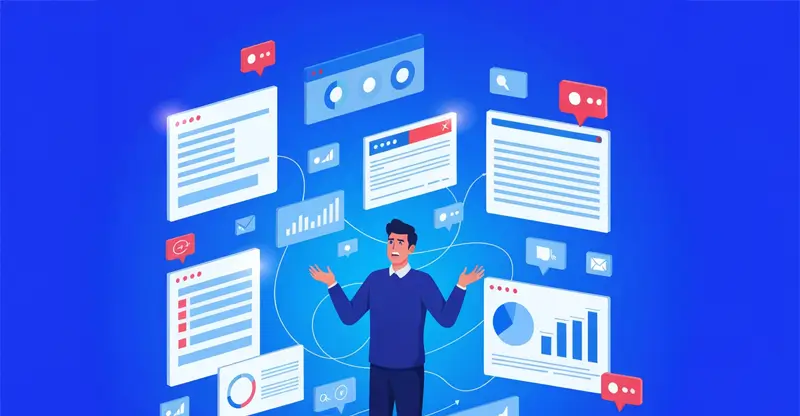
Workplace environments driven by digital tools have contributed to a growing issue of information overload. A report from IDC reveals that knowledge workers spend nearly 30% of their day searching for information, highlighting the inefficient nature of managing multiple platforms for communication and collaboration. This constant influx of data, combined with the fear of missing out (FOMO), creates digital stress, negatively impacting mental health and productivity. A study by The Journal of Business Communication links this rising stress to the overwhelming reliance on fragmented digital tools, leading employees to feel constantly “on” and anxious about missing critical information.
Clariti addresses this problem by streamlining communication through its “connected conversations” feature. By integrating emails, chats, documents, and calendar events into organized, contextual conversations, Clariti minimizes the chaos and allows users to stay focused without jumping between multiple apps.
This helps teams manage digital stress and stay informed without feeling overwhelmed. Instead of constantly worrying about losing important data in scattered conversations, employees can stay on top of information flow seamlessly.
10 ways Clariti’s Connected Conversations can alleviate digital stress and FOMO in the workplace.
1. Reducing App Overload by Centralizing Communications
Clariti combines emails, chats, documents, and calendar events into a single, organized platform. Instead of switching between multiple apps, users can view all relevant communications in context under one conversation thread. Research shows that the average employee switches between 10 apps over 25 times per day, resulting in significant productivity losses and stress.
By eliminating the need for constantly jumping between apps, Clariti drastically reduces mental fatigue and increases focus. For example, when a project update is needed, users can simply refer to the connected conversation containing all related chats, emails, and files, reducing the cognitive load associated with retrieving scattered information.
2. Enhanced Contextual Understanding to Minimize FoMO
One of the key features of Clariti’s connected conversations is the ability to automatically organize communications around a specific topic or project. This ensures that teams have complete visibility of all relevant discussions and information without the fear of missing crucial updates.
A survey by Udemy found that 84% of millennials experience FoMO, especially in fast-paced digital workplaces. For instance, when working on a collaborative project, employees can effortlessly follow conversations without worrying about missing important context, as Clariti’s AI gathers all the relevant communication into one clear conversation.
3. Minimizing Unnecessary Notifications
A significant contributor to digital stress is the constant barrage of notifications. According to Asana’s Anatomy of Work Index, 41% of workers say they frequently receive more notifications than they can manage. Clariti reduces this noise by keeping communications contextual. Instead of receiving multiple fragmented notifications from different platforms, users receive streamlined, relevant updates in one place. For example, when working on a deadline-driven project, users don’t have to wade through hundreds of unnecessary notifications but can focus on updates directly linked to their work.
4. Streamlined Task Management with Integrated To-Dos
Clariti’s integration of task management within connected conversations enables employees to convert messages into to-dos directly from the chat or email thread. This reduces the stress of forgetting tasks or missing deadlines amidst the clutter of messages.
A report by Workplace Insight found that employees spend an average of 13 hours per week on emails, much of which is spent trying to track action items. With Clariti, action items are automatically tracked in the conversation thread, ensuring that no task is overlooked. For instance, when a client sends an important request via email, the user can immediately assign it as a to-do, ensuring prompt action.
5. Increasing Productivity by Reducing Search Time
Studies show that employees spend around 20% of their time searching for internal information. Clariti’s connected conversations reduce the time spent looking for scattered information, allowing employees to quickly locate the emails, chats, and documents they need, organized by project or topic. For example, when preparing for a meeting, instead of searching multiple platforms for documents, the team can instantly access all relevant materials within the same conversation, leading to a smoother workflow and reduced stress.
6. Improving Work-Life Balance by Reducing Digital Overload
With Clariti’s integrated communication approach, employees can better organize their digital interactions, reducing the amount of time spent after hours sifting through unnecessary emails and messages. According to a study by Deloitte, 77% of professionals experience burnout due to prolonged exposure to workplace stress . By providing a more structured communication system, Clariti allows workers to “disconnect” without the fear of missing critical updates.
For instance, when an employee logs off for the day, they can easily catch up on missed conversations in the morning, as all communications related to a project are in one place, reducing the compulsion to check emails or messages continuously outside of work hours.
7. Boosting Accountability and Transparency through Organized Conversations
Clariti’s connected conversations create a clear record of communication, making it easier for teams to stay accountable for their actions and follow up on tasks. Lack of transparency and miscommunication are key contributors to workplace stress and project delays. A survey by The State of the American Workplace found that 70% of employees feel disconnected due to unclear goals and communication. Clariti enhances transparency by automatically documenting who said what, when, and why.
For example, in a cross-functional team project, all contributions, ideas, and decisions are tracked in the conversation, leaving no room for misinterpretation or missed updates.
8. Reducing Cognitive Load with Simplified Collaboration
Cognitive overload occurs when employees have to manage multiple tasks, messages, and platforms. According to McKinsey, employees report feeling overwhelmed by the number of digital tools they have to use for collaboration, leading to stress and a reduction in productivity. Clariti addresses this by consolidating all forms of communication—email, chat, documents—into a single thread, simplifying the collaboration process.
For instance, instead of using different apps for emailing clients and chatting with teammates, employees can handle all forms of communication within Clariti, reducing the mental effort required to keep track of conversations across platforms.
9. Minimizing Information Silos
Information silos often create stress as important data or updates can be missed when different departments use separate communication tools. Research by Harvard Business Review shows that 47% of employees believe that digital tools contribute to silos, making collaboration more difficult. Clariti eliminates silos by ensuring that every member of the team, across departments, has access to the same communication threads and contextual information.
For example, when the sales and marketing teams need to collaborate on a campaign, they can easily access shared conversations and materials in Clariti without switching tools or duplicating efforts.
10. Enabling Asynchronous Work to Ease FOMO
As remote and hybrid work models become more common, asynchronous communication has become essential. Clariti supports asynchronous work by allowing team members to access all necessary information from past emails, chats, and documents without needing to be “always on.” This helps reduce FOMO and digital stress, as employees don’t feel pressured to respond immediately or be present in every conversation. A Buffer study on remote work found that 52% of employees feel more productive with the flexibility of asynchronous communication.
For example, if a team member is in a different time zone, they can simply catch up on the project-related conversation later without the fear of missing critical updates.
Case Study: Reducing Digital Stress for a Marketing Agency with Clariti
Client Profile: A mid-sized marketing agency with a distributed team of 75 employees spread across multiple time zones was facing significant digital stress. Their work required constant collaboration between creative, account management, and technical teams. While they were adept at using various digital tools, their reliance on multiple platforms for communication and collaboration led to serious productivity issues, employee burnout, and high turnover rates.
Challenges Faced:
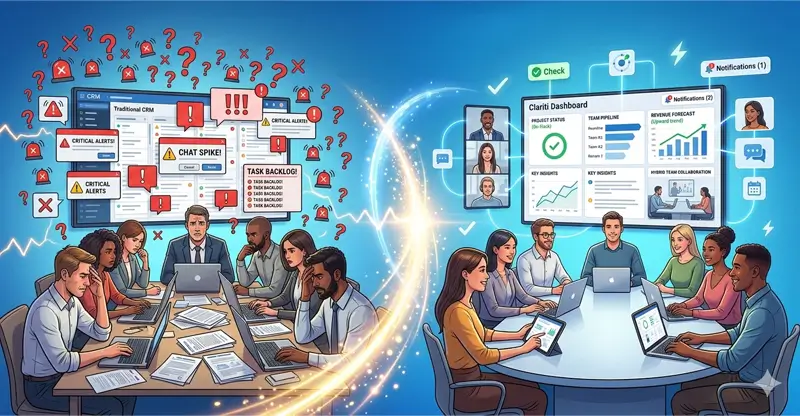
- Technostress Due to Multiple Digital Tools: The agency used several digital tools for various tasks, including emails, instant messaging apps, document sharing platforms, and voice calling. Managing these platforms became chaotic, leading to technostress, as employees struggled to keep track of messages, deadlines, and updates across multiple channels.
- Information Overload Due to Frequent Interruptions: The team was constantly bombarded by notifications from emails, chats, and project management systems, causing frequent interruptions. Important information often got buried under a flood of messages, making it difficult for employees to focus and prioritize tasks. The stress of keeping up with everything led to frustration and mistakes.
- Work-Life Conflicts and Email Addiction: The team’s reliance on email created a toxic “always-on” work culture. Employees felt compelled to check emails after work hours and respond immediately, contributing to work-life conflicts. Email addiction led to increased anxiety and stress, with employees feeling like they could never fully disconnect from work.
- Workplace Burnout: The combination of technostress, constant interruptions, and email overload led to workplace burnout. Employees were exhausted from managing different tools, struggling with productivity, and feeling overwhelmed by the volume of work and communication.
- Fear of Missing Out (FOMO): Employees suffered from FOMO due to the constant stream of messages and updates across different channels. They worried about missing critical information or being left out of important conversations, which added to their anxiety and digital fatigue.
Solution: Implementing Clariti’s Connected communications
After a comprehensive analysis, the agency decided to implement Clariti, an AI-powered connected communication platform, to simplify and centralize all their digital communications. Clariti’s ability to combine emails, chats, documents, and calendar events into contextual conversations provided the structure and organization the agency desperately needed.
Steps Taken:
- Centralized Communication: With Clariti, the agency could integrate all forms of communication—emails, chats, documents, and calendar events—into a single platform. This eliminated the need to juggle multiple apps, reducing technostress and simplifying the team’s workflow. By connecting conversations to specific projects and topics, employees no longer had to search through different platforms for information.
- Organized Conversations with Context: Clariti’s AI-powered platform automatically added context to each conversation, organizing them by subject and project. This feature helped the team reduce information overload, as they could easily find relevant discussions, files, and emails in one place, without worrying about losing important updates.
- Reducing Work-Life Conflicts and Email Addiction: Clariti’s connected conversations feature allowed employees to better manage their work without feeling the need to constantly check emails. As emails were integrated into the same platform as chats and project updates, there was no fear of missing out on important information. Employees could confidently disconnect after work hours, knowing that they could catch up on project-related conversations the next day.
- Enhanced Focus and Reduced Interruptions: By using Clariti’s contextual conversations, employees could focus on specific projects without being interrupted by unrelated messages. The reduction in app-switching and more structured communication allowed the team to work more efficiently, minimizing distractions and boosting productivity.
- Asynchronous Collaboration: Clariti enabled asynchronous work, which allowed the agency’s distributed team to collaborate effectively across time zones. Employees no longer needed to be present in real-time for every conversation, as Clariti’s conversation history allowed them to catch up on relevant discussions whenever they logged in. This reduced stress, as employees didn’t feel pressured to respond immediately.
Results:
After implementing Clariti, the marketing agency experienced significant improvements:
- Reduced Technostress: By centralizing communication, employees no longer felt overwhelmed by managing multiple tools.
- Increased Productivity: Organized, contextual conversations reduced interruptions and helped employees stay focused on their tasks.
- Improved Work-Life Balance: Employees felt more in control of their work schedules, and email addiction decreased.
- Reduced Burnout: With fewer distractions and better communication management, employee morale improved, and burnout rates decreased.
- Decreased FOMO: The team no longer felt anxious about missing important updates, as everything was organized and easily accessible on one platform.
In the first quarter after the implementation, the agency reported a 20% increase in productivity, a 15% reduction in employee turnover, and a 30% improvement in employee satisfaction, as measured through internal surveys.
Conclusion
Clariti’s connected conversations offer a transformative solution to combat digital stress and FOMO in the workplace. By unifying emails, chats, documents, and events into contextually organized conversations, Clariti reduces the chaos and fragmentation caused by switching between multiple digital tools. This centralized approach not only improves team communication but also enables employees to focus on their tasks without constant interruptions or fear of missing out on important information.
Clariti’s intelligent organization of information minimizes technostress and workplace burnout, fostering a healthier work-life balance. As digital stress continues to impact productivity and well-being in modern work environments, adopting tools like Clariti can significantly enhance overall team efficiency and mental health, allowing teams to work smarter and more collaboratively.

Start for FREE with Personal CRM
We too hate spam! Your email is secure with us.

Spot secured. You're in.
You’re officially on the list for early access to Clariti.


No more switching tools.

No more lost context.

Just Clarity.
You’ll be among the first to experience it when we launch. We’ll let you know the moment it’s ready.

Keep an eye out for emails from @clariti.app.
(and check your spam folder just in case—whitelisting us helps ensure you don’t miss a thing).