



- Published on
- 10 min read
Customer relationship tools are changing fast. Many businesses now want more than old-style CRM systems. Traditional CRM often focuses only on sales, but modern teams need better ways to manage all relationships.
Studies show this shift clearly. According to Salesforce, 66% of customers expect companies to understand their unique needs and expectations.
HubSpot reports that sales teams spend only about 28% of their week actually selling, while the rest goes to admin tasks like CRM updates.
This is why many companies are now exploring crm alternatives and searching for the best crm alternatives that reduce manual work and improve team collaboration.
Modern businesses want tools that connect emails, chats, files, and meetings in one place. They need systems that build relationship intelligence naturally instead of forcing teams into rigid workflows. This is where Clariti stands out.
The Biggest Problems with Traditional CRM Systems
Traditional CRM tools often create more work instead of reducing it. Teams must manually enter data, update records, and manage customer details constantly.
Common problems include:
- Too much manual data entry.
- Sales-only focus.
- Limited support for other teams.
- Disconnected communication tools.
- Lost context between emails, chats, and files.
This makes many businesses look for better crm alternatives.
What Modern Teams Expect From CRM Alternatives in 2026
Today’s teams need CRM systems that fit how work really happens. Relationships are built through many channels, not just sales emails.
Modern teams need:
- Email, chat, files, and calendar in one place.
- Easy collaboration across departments.
- Automatic tracking of relationship history.
- Less app switching.
- Better visibility into customer and team interactions.
The best crm alternatives support full business communication, not just sales pipelines.
How Clariti Redefines CRM for Modern Teams
Clariti is built differently from traditional CRM systems. It works as both a personal and team CRM.
Instead of forcing users to enter every detail manually, Clariti builds Customer Relationship Intelligence automatically through daily communication.
Clariti offers:
- No rigid workflows.
- Personal and team CRM in one.
- Emails, chats, files, and calendar are fully connected.
- Automatic relationship enrichment.
- Less manual admin work.
This makes work feel more natural and less stressful.
Clariti’s Core Features That Replace Traditional CRM
1. Contextual Email Management
Email is still one of the most important business communication tools. But in many traditional CRM systems, emails often remain separate from customer records unless someone manually logs them. This creates extra work and increases the risk of missing important details.
Clariti solves this by automatically connecting emails to the right people, companies, and conversations. Every email becomes part of a larger relationship history. Teams can easily see past discussions, follow-ups, and important decisions without searching through scattered inboxes.
This approach saves time, improves visibility, and ensures valuable communication is never lost.
Benefits include:
- Full email history in context.
- No copy-paste into CRM.
- Better relationship tracking.
- Easier customer follow-up.
2. Subject-Based Chat for Team Collaboration
Team communication can quickly become confusing when chats are scattered across different apps or buried in endless message threads. Traditional tools often separate chat from customer or project context.
Clariti organizes chats by subject, making conversations easier to follow. Teams can instantly understand why a discussion started, what decisions were made, and how it connects to emails, meetings, or files.
This structure reduces confusion, improves collaboration, and helps teams stay aligned on important work.
Key benefits:
- Team members see the full discussion history.
- Better collaboration.
- Less confusion.
- Easier project tracking.
3. Calendar with Full Relationship Context
Meetings are more productive when teams have full context before they begin. In many systems, calendar events exist separately from related emails, chats, or documents.
Clariti links calendar events directly to the conversations and files behind them. This means every meeting includes its full backstory. Team members can prepare faster, make better decisions, and avoid wasting time searching for old information.
This creates smoother workflows and stronger business communication.
This means:
- Meeting context is always available.
- Better preparation.
- Easier scheduling.
- Improved decision-making.
4. File Management with Full Conversation History
Files often lose meaning when they are separated from the conversations that explain them. Teams may struggle to remember who shared a file, why it was important, or which version was approved.
Clariti keeps files connected to their full communication history. Every shared document includes the surrounding emails, chats, and context.
This makes file management easier, improves accountability, and helps teams work with more confidence.
Advantages:
- Know who shared what.
- Easy file tracking.
- Better version control.
- Reduced information loss.
Clariti vs Traditional CRM: Key Differences
|
Feature
|
Traditional CRM
|
Clariti
|
|---|---|---|
|
Data Entry
|
Manual
|
Automatic
|
|
Team Access
|
Mostly sales
|
Entire organization
|
|
Communication
|
Fragmented
|
Unified
|
|
Workflow
|
Rigid
|
Flexible
|
|
Context
|
Limited
|
Full relationship history
|
This is why more teams now consider Clariti among the best crm alternatives.
Why Teams Are Looking for CRM Alternatives
Businesses today face more communication challenges than ever before. Teams work across multiple platforms, manage remote collaboration, and handle growing amounts of customer and internal data. Traditional CRM systems often cannot keep up with these changing needs.
Many companies are switching because they want tools that simplify work instead of adding more complexity. Old CRM systems often require constant updates, manual data entry, and switching between several apps just to complete simple tasks. This slows teams down and creates frustration.
Modern businesses want smarter systems that connect communication, collaboration, and relationship management in one place. Clariti helps by reducing scattered workflows and making information easier to access.
Key reasons teams are switching include:
- Less manual data entry.
- Reduced app switching.
- Better team communication.
- Full relationship visibility.
- Improved productivity.
- Easier collaboration across departments.
- Faster decision-making.
- More natural workflows.
By moving to more connected platforms, businesses can save time, improve efficiency, and focus more on building strong relationships.
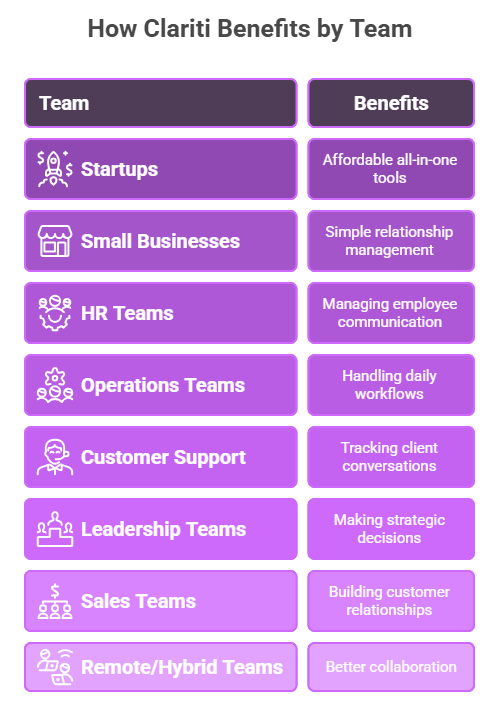
Who Benefits Most from Clariti
Clariti is designed for more than just sales teams. Since it combines communication, collaboration, and CRM functions, it supports a wide range of business roles.
Many organizations struggle because different departments use separate tools. This creates silos, miscommunication, and lost context. Clariti solves this by giving multiple teams one connected workspace.
Teams that benefit most include:
- Startups needing affordable all-in-one tools.
- Small businesses wanting simple relationship management.
- HR teams managing employee communication.
- Operations teams handling daily workflows.
- Customer support teams tracking client conversations.
- Leadership teams making strategic decisions.
- Sales teams building customer relationships.
- Remote and hybrid teams needing better collaboration.
Clariti works especially well for businesses that want to reduce tool overload while improving team alignment.
Business Outcomes Teams See After Switching to CRM Alternatives
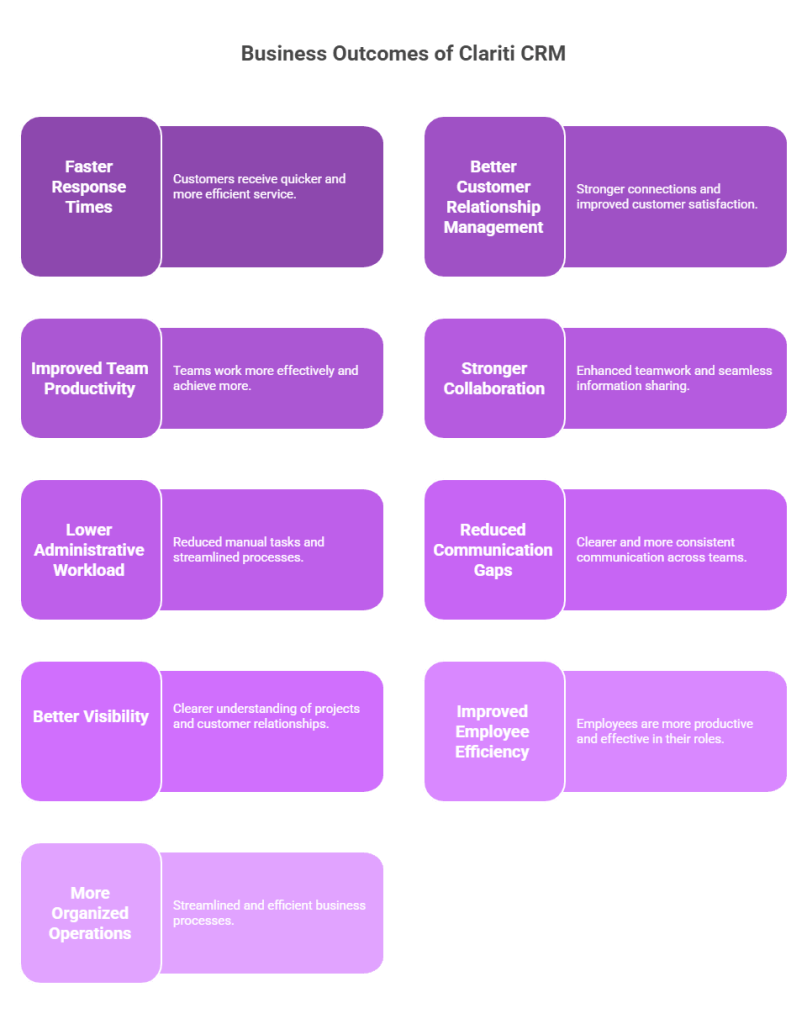
When businesses move from traditional CRM systems to Clariti, they often see major improvements in both daily operations and long-term performance.
Because Clariti connects emails, chats, files, and calendars, teams spend less time searching for information and more time doing productive work. Communication becomes clearer, relationships become easier to manage, and workflows become smoother.
Common business outcomes include:
- Faster response times.
- Better customer relationship management.
- Improved team productivity.
- Stronger collaboration.
- Lower administrative workload.
- Reduced communication gaps.
- Better visibility into projects and relationships.
- Improved employee efficiency.
- More organized business operations.
These improvements help companies make better decisions, strengthen customer trust, and create more scalable systems for growth. For many organizations, switching is not just about replacing CRM software—it is about improving how the entire business works.
Customer Story: How Modern Teams Improved Relationship Management with Clariti
Many businesses start with traditional CRM systems because they seem like the standard choice. But over time, teams often face the same problems. They spend too much time entering data, searching for old emails, updating customer records, and switching between apps.
One growing business faced these exact issues. Their sales, support, and operations teams all used different tools. Customer details were spread across emails, spreadsheets, chat apps, and calendars. Important information was often missed, and teams struggled to stay aligned.
After switching to Clariti, their workflow became much simpler. Emails, chats, files, and meetings were all connected in one place. Relationship history built itself automatically as teams worked.
Results they experienced:
- Faster customer follow-ups.
- Better team communication.
- Less manual CRM work.
- Improved visibility across departments.
- Stronger customer relationships.
- Reduced confusion and missed details.
By using Clariti, the business moved from disconnected communication to full relationship intelligence.
Migration Guide: Moving from Traditional CRM to Clariti
Switching CRM systems may feel difficult, but a clear process makes it easier. Clariti is designed to reduce complexity and fit naturally into team workflows.
Step 1: Review Current CRM Challenges
Start by identifying what is not working.
Ask questions like:
- Is manual data entry slowing teams down?
- Are communication tools disconnected?
- Is relationship history incomplete?
- Are teams switching between too many apps?
This helps define why change is needed.
Step 2: Organize Existing Data
Before migration, gather:
- Customer records.
- Contact lists.
- Email histories.
- Shared files.
- Calendar events.
This ensures smoother onboarding.
Step 3: Set Up Clariti Workspaces
Clariti allows teams to create connected communication spaces for:
- Sales
- HR
- Operations
- Customer support
- Leadership
This helps each team work naturally.
Step 4: Train Teams on Context-Based Workflows
Unlike traditional CRM, Clariti focuses on hybrid conversations.
Teams should learn:
This improves adoption.
Step 5: Monitor and Optimize
After migration:
- Review productivity gains.
- Track reduced admin work.
- Improve team collaboration.
- Adjust workflows as needed.
This ensures long-term success.
Before and After: Relationship Intelligence Transformation
Before Clariti
Traditional CRM systems often create fragmented workflows.
Common issues include:
- Manual contact updates.
- Scattered communication.
- Separate email and CRM systems.
- Missing relationship history.
- High admin workload.
- Limited team collaboration.
- Poor context for meetings and files.
Relationship management often depends on constant user input.
After Clariti
Clariti creates automatic Customer Relationship Intelligence.
Key improvements include:
- Emails linked automatically.
- Chats organized by subject.
- Calendar events with full context.
- Files connected to communication history.
- Personal and team CRM combined.
- Reduced app switching.
- Full visibility into relationships.
Teams gain a complete picture of every customer, project, and business interaction.
The Real Shift: From CRM to CRI
The biggest difference is that traditional CRM tracks data, while Clariti builds intelligence.
Traditional CRM asks teams to manually record relationships.
Clariti allows relationships to grow naturally through connected communication.
This shift helps businesses:
- Save time.
- Improve decisions.
- Build stronger customer trust.
- Support all departments.
- Scale more effectively.
For modern businesses, this is why many are moving away from old CRM systems and choosing smarter crm alternatives like Clariti.
Is Clariti the Future of CRM?
Traditional CRM systems were designed for a different time. Today, work happens across chats, emails, files, and meetings.
Clariti reflects this new reality by building Customer Relationship Intelligence through connected communication.
For many businesses, this represents the next step beyond traditional CRM.
Conclusion
Traditional CRM systems often create extra work through manual updates, rigid workflows, and disconnected tools. Modern teams now need better solutions that fit real work habits.
Clariti offers a smarter approach by connecting emails, chats, files, and calendars into one platform. It helps teams reduce app switching, improve collaboration, and build stronger relationship intelligence naturally.
As businesses search for crm alternatives and the best crm alternatives, Clariti stands out as a modern option that supports entire teams, not just sales. For organizations that want simpler workflows and better relationship management, Clariti is becoming a powerful choice.
Frequently Asked Questions
What are the best CRM alternatives for modern teams?
Many businesses now look for CRM tools that combine communication, collaboration, and relationship management.
Why do companies switch from traditional CRM systems?
Teams often switch to reduce manual work, improve productivity, and simplify workflows.
What should businesses look for in a CRM alternative?
Important features include automation, team collaboration, unified communication, and easy scalability.
Are CRM tools only useful for sales teams?
No, modern CRM platforms can support HR, operations, customer support, and leadership teams too.
How can better CRM tools improve business productivity?
They can reduce admin tasks, improve communication, and help teams manage relationships more effectively.



Start for FREE with Personal CRM
We too hate spam! Your email is secure with us.

Spot secured. You're in.
You’re officially on the list for early access to Clariti.


No more switching tools.

No more lost context.

Just Clarity.
You’ll be among the first to experience it when we launch. We’ll let you know the moment it’s ready.

Keep an eye out for emails from @clariti.app.
(and check your spam folder just in case—whitelisting us helps ensure you don’t miss a thing).