



- Published on
- 10 min read

Blog Summary
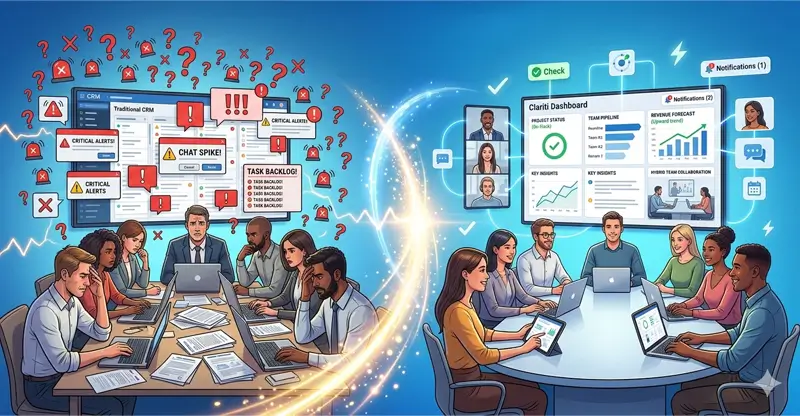
Traditional CRM systems were built to manage records, but they miss what actually drives customer relationships: conversational context. When your team's emails, chats, calls, and shared files exist in separate silos, the intelligence that matters, the why behind each interaction, gets lost.
Sales reps now spend less than 30% of their time actually selling. The rest disappears into context-switching, data entry, and reconstructing conversations from fragmented sources. Meanwhile, B2B buyers engage across 10+ channels and expect your team to remember their full history without repetition.
The core issue isn't user discipline or training gaps. It's architectural. Systems that separate where conversations happen from where relationships are "managed" create organizational amnesia.
Customer Relationship Intelligence (CRI) offers a different path:
- Preserves context by connecting communication threads naturally
- Unifies emails, chats, calls, and files around the relationship itself
- Eliminates manual translation between tools
When communication channels unify, teams stop performing administrative busywork and start maintaining genuine relationship continuity. Context follows the conversation automatically.
View more
We conflated ‘record’ with ‘relationship’.
For two decades we believed that if we capture enough fields for deal size, lead source, last contact, industry we captured the truth of the customer. We call the CRM the “single source of truth.” But open any profile and you still feel it: a record tells you nothing about the actual temperature of the room.
The record is here. Intelligence is missing.
At the heart of this failure is a gap we’ve normalized: the invisible wall between where we talk and where we “manage.” We’ve separated the conversation from the record, and in doing so, we’ve built systems that are designed to help us forget.
CRM was built for the person watching the dashboard, not the person doing the work.
This explains many of the symptoms modern teams experience sales reps’ resentment toward CRM systems, incomplete data, adoption resistance, fragmented workflows, and the feeling that the system itself is an afterthought. The problem was never a lack of discipline. The systems themselves were disconnected from how relationships naturally evolve through conversations, context, and continuity.
This blog explores why traditional CRM systems fail to preserve conversational context and why unified communication is becoming essential to modern customer relationships.
Why Your Sales Team Quietly Resents CRM
There’s a particular kind of exhaustion that comes from systems that don’t match how work actually happens.
Your sales representatives spend their days navigating conversations across multiple channels email threads that evolve over weeks, chat messages that require quick decisions, calls that shift the direction of a deal, files that get shared and revised and discussed. The relationship lives in this flow.
And then, at the end of it, to make it “official” they’re asked to step outside that flow and perform data entry; where they log the “what” but lose the “why.”
Gartner research indicates that sales reps use an average of 10 different tools to close a single deal. Ten different systems, ten different contexts, ten different places where relationship intelligence might live or get lost.
The CRM system becomes one more tool in the stack, often the least connected to where actual conversations happen. It sits at the end of the workflow rather than inside it, demanding attention without offering context in return.
This is why adoption remains a persistent challenge. Forrester data suggests that nearly 50% of CRM implementations fail to meet expectations, often because the systems require behavioral change that conflicts with how people naturally work.
Your team doesn’t resist process. They resist workflows that feel disconnected from reality.
The Real Productivity Drain Nobody Talks About
This isn’t just a productivity drain; it’s an emotional one. When communication is fragmented across email clients, messaging apps, video platforms, and file drives, our organizational memory becomes a series of broken threads. We find ourselves asking the same questions twice, missing the subtle context of a client’s frustration, and moving through our day with a low-level anxiety that we’ve missed something critical buried in an inbox we haven’t checked in an hour.
The data bears out this quiet exhaustion. According to the Asana Anatomy of Work Index 2024, knowledge workers now spend nearly 60% of their time on “work about work” searching for information, switching between apps, and communicating about the work rather than actually doing it.
Similarly, Salesforce’s State of Sales report consistently reveals that sales reps spend less than 30% of their week actually selling. The rest is swallowed by data entry, administrative hurdles, and context-switching.
We read statistics like this and treat them as operational inefficiencies to be optimized. But they are actually symptoms of a deeper architectural fracture. We are drowning in the logistics of our own tools.
Why Traditional Sales CRM Software Feels Like Administrative Burden
The traditional Enterprise CRM was never actually built for the person doing the work. It was built for the person watching the dashboard.
The architecture prioritizes reporting pipeline stages, conversion rates, activity metrics, and forecast accuracy. These are valuable for management visibility. They’re less valuable for the account executive trying to remember what a client said three weeks ago, or the customer success manager trying to understand the full history of a relationship before a renewal conversation.
The CRM system excels at administrative structure. What it lacks is communication intelligence.
McKinsey research highlights that B2B customers now engage across ten or more channels throughout their buying journey. The relationship unfolds across email, chat, video calls, social media, in-person meetings, and everything in between. A system designed to capture static records cannot preserve the continuity of a relationship that moves fluidly across channels.
We’ve quietly accepted a world where we spend more time “updating the system” than understanding humans on the other side of the screen. We’ve prioritized the infrastructure of the sale over the continuity of the conversation.
And somehow, we’ve convinced ourselves this is normal.
From CRM to CRI: Customer Relationship Intelligence
There’s a shift happening beneath the surface – a slow movement away from the heavy, administrative burden of traditional platforms toward something more lightweight and human-centered.
We’re beginning to see the emergence of what might be called Customer Relationship Intelligence (CRI).
The distinction is subtle but profound. If a CRM is about managing records, CRI is about understanding context.
Intelligence doesn’t live in a “Status” dropdown menu. It lives in hybrid conversations – the ability to see emails, chats, calls, and files in one continuous thread. It’s the recognition that a customer relationship isn’t a series of linear pipeline stages. It’s a living, breathing history of decisions and follow-ups and small moments that shaped the trajectory of trust.
Traditional CRM systems ask: what stage is this deal in?
Customer Relationship Intelligence reveals: here’s everything we know about this relationship, across every conversation we’ve had – internal & external, preserved in context rather than flattened into fields.
According to Deloitte’s 2024 Global Marketing Trends, customers increasingly expect brands to understand their history and preferences without requiring repetition. The tolerance for fragmented experiences is decreasing. Context has become a competitive advantage.
CRI represents a move toward systems that build intelligence naturally from the communication that’s already happening, rather than requiring manual translation into administrative structures.
What Happens When Your CRM System Loses Context
Where Customer Intelligence Goes
When your emails, chats, calls, and files live in separate silos from your relationship history, your database becomes a graveyard of dead data. It is where information goes to be stored, not where it goes to live.
Somewhere between the email threads, the internal debates on chat, and the meeting notes, relationship memory started disappearing.
How Fragmented Communication Destroys Customer Relationships
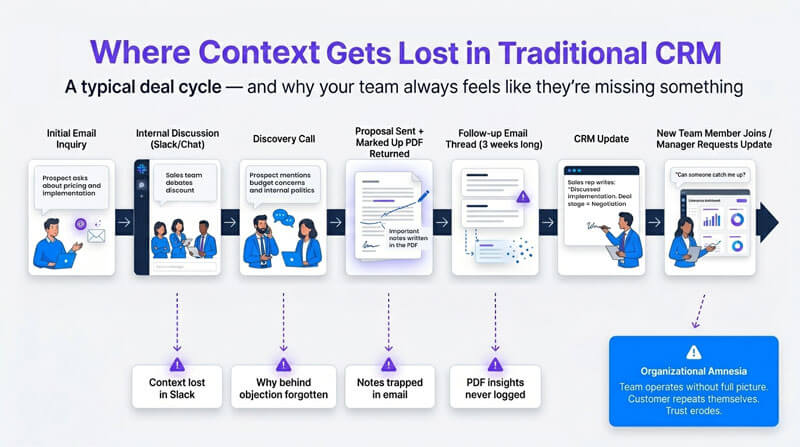
Consider what actually happens during a typical deal cycle.
Your account executive receives a pricing question via email. She responds, then discusses discount approval in an internal chat. Later, the prospect calls with implementation questions. During the call, they reference concerns from a previous email, but which one? She scrambles to find it mid-conversation.
After the call, she updates the CRM system with “discussed implementation.”
Three days later, her manager asks about deal status. She explains again. A solutions engineer gets looped in. She summarizes again. The prospect emails a question to the general inbox. A different team member responds without context.
The prospect notices.
Not dramatically. Not enough to complain. Just enough to feel like they’re repeating themselves. Just enough to sense your team isn’t quite as coordinated as they expected.
According to McKinsey research on B2B customer experience, 75% of buyers now expect consistent interactions across departments. When context fragments, customers feel it before you measure it.
The Trust Artifacts Your CRM System Ignores
If we want to understand why teams resist traditional workflows, we must recognize what those workflows ask them to leave behind.
Trust is not built in a dropdown menu. Trust is built on the margins.
It’s the PDF proposal a client marked up and sent back via email. It’s the internal chat where your sales engineer flagged a technical concern before the demo. It’s the calendar invite that got rescheduled three times, signaling a shift in the prospect’s internal priorities.
These artifacts matter. They carry the weight of the relationship. When we force teams to abandon these artifacts to go “update the deal stage,” we are asking them to sever the context from the outcome. Over time, teams stop trying to bridge the gap. They keep their real context in their personal inboxes and their private chats, and they feed the system just enough to keep management at bay.
The system remains clean. The organization remains blind. This is why unified communication isn’t just an IT initiative or a technical requirement. It is a strategic necessity for relationship survival.
Why Unified Communication Is the Foundation of Modern CRM
When we shift our lens from management to intelligence, we stop asking our teams to be data entry clerks. We stop treating communication as something that happens outside the CRM system and start treating communication as the system.
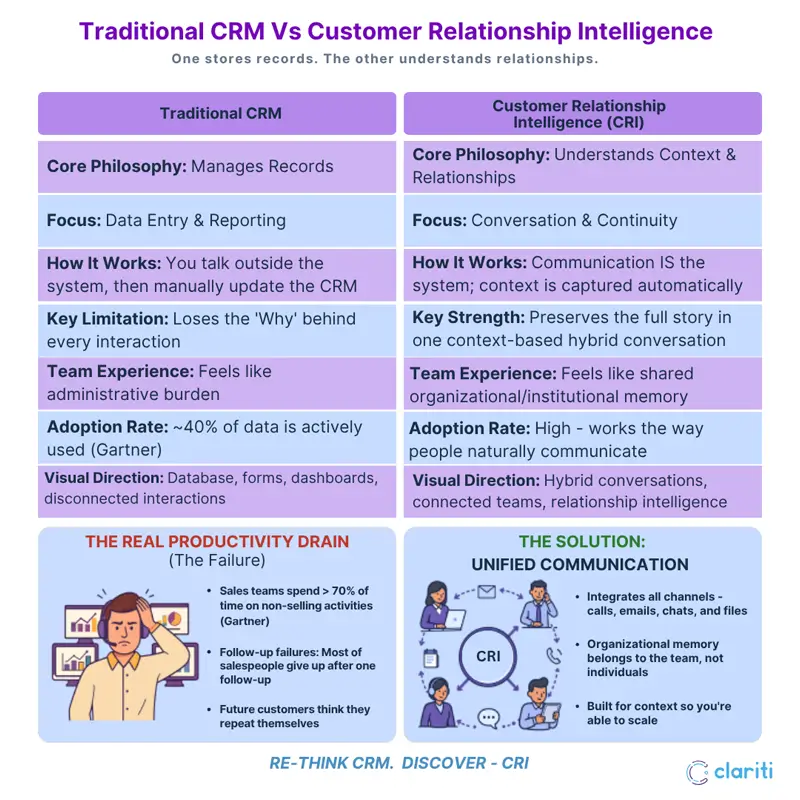
Research from Gartner on CRM usage shows that less than 40% of CRM data is actively used by sales teams. The reason isn’t lack of discipline, but that data captured doesn’t reflect how the relationship actually evolved.
When email chains, chat messages, call recordings, and shared files remain disconnected from your CRM software, you don’t have relationship intelligence. You have fragmented activity logs that require constant human translation to be useful.
Personal-to-Team CRM: Where Context Becomes Shared Memory
Historically, we’ve swung between two extremes. On one side, the rigid enterprise database that strips away humanity for the sake of scale. On the other, the personal rolodex, lightweight and intuitive, but entirely siloed, creating massive organizational risk when an individual leaves the company.
Modern work requires a missing middle: the Personal-to-Team CRM.
Research from MIT Sloan suggests that effective collaboration requires shared context, not just shared access. Teams that can see the full history of a conversation make better decisions and move faster than teams working from fragmented information. It is a space where the context follows the person, and the memory belongs to the organization.
Imagine a workspace where an account executive doesn’t have to summarize a complex, three-week negotiation for their manager. The manager can simply view the intelligence thread seeing the emails, the async voice notes, the shared files, and the internal chats woven together contextually.
The handoff to the implementation team doesn’t require a “download meeting”. The implementation team simply inherits the conversation thread, complete with its history and nuances.
Intelligence becomes a natural byproduct of the work itself, rather than an extra chore added to the end of the day. When emails, chats, calls, and files live in contextual threads connected by relationship rather than separated by channel, organizational memory stops depending on individual recall. The context follows the conversation, not the other way around.
How Clariti Solves CRM Adoption Through Unified Communication
The Architecture of Shared Organizational Memory
Rather than building another destination where work goes to be summarized, Clariti operates as a unified communication layer that connects the artifacts of your day. Emails, chats, calls, files, calendar events, and tasks are woven into contextual hybrid conversations.
It is a browser-based, zero-install cloud platform that meets teams exactly where they are. There is no friction of switching contexts, because the context is already preserved.
How Intelligence Threads Work in Practice
When you are discussing a client in Clariti, everything related to that relationship stays connected:
- The initial email inquiry
- Internal chat discussing pricing strategy
- The demo call notes
- The proposal PDF shared via email
- Follow-up questions in chat
- Calendar invites for implementation kickoff
- Task reminders for contract review
You don’t have to decide what is important enough to log; the system understands that the conversation itself is the intelligence.
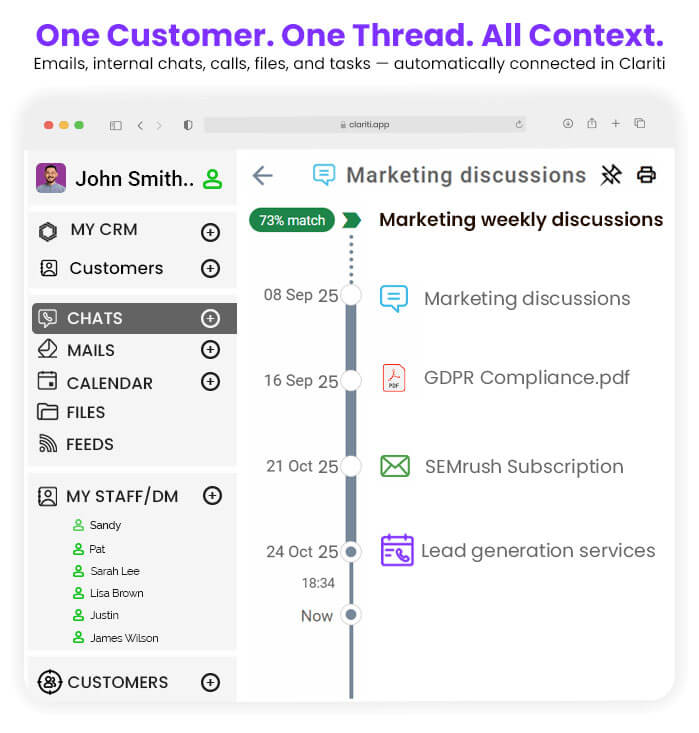
It feels less like pipeline administration and more like shared organizational memory.
Why Context Continuity Matters More Than Data Entry
By unifying the chats where work actually happens, Clariti allows teams to move from a state of constant, anxious reconstruction to a state of confidence.
You always know the history. You always have the context. You never have to ask a client to repeat themselves.
According to Harvard Business Review research on sales effectiveness, the top-performing sales teams share one critical characteristic: they maintain relationship continuity across every customer interaction. They don’t just track activities they preserve conversational context.
That’s not possible when your CRM system lives separately from your communication tools.
The Strategic Shift: From Managing Data to Honoring Conversations
Why Communication-First Systems Win
The tension we feel in modern work that pervasive sense of being incredibly busy but strangely disconnected is a signal that our systems are out of alignment with our behavior. We are communication-heavy, but context-poor.
To solve this, we don’t need more “management.” We need more continuity.
A study by Twilio found that 83% of consumers expect to interact with someone immediately when contacting a company, and 75% expect whoever they reach to already have context on their previous interactions. The expectation of continuity has become table stakes.
We need systems that recognize that a file sent in a quick chat is just as important to the relationship as a formal contract sent via email. We need a workspace that understands that the true intelligence of a partnership is found in the threads between the artifacts, not just the artifacts themselves.
Rethinking What a CRM System Should Actually Do
As we rethink how we engage with our customers, the goal shouldn’t be to build a bigger, more rigid database. The goal should be to create a space where conversations can breathe, where context is naturally preserved, and where the “relationship” is finally more than just a line item in a spreadsheet.
Perhaps the most strategic thing a business can do today is to stop managing the data and start honoring the conversation.
Frequently Asked Questions
Why do CRM systems fail without unified communication?
CRM systems fail because they capture records, not relationships. When communication is fragmented across emails, chats, calls, and files, the conversational context that defines customer relationships gets lost, turning the CRM into a graveyard of dead data.
How does poor communication integration affect CRM adoption?
Nearly 50% of CRM implementations fail because they require behavioral changes that conflict with natural workflows. When teams step outside their communication flow to perform data entry, they quietly resist keeping real context in personal inboxes while feeding the system just enough to satisfy management.
What challenges arise from disconnected CRM communication tools?
Sales reps use an average of 10 different tools to close a single deal, creating fragmented organizational memory. Knowledge workers spend nearly 60% of their time on “work about work” searching for information, switching apps, and reconstructing context rather than doing productive work.
How do separate communication channels hurt customer experience?
75% of B2B buyers expect consistent interactions across departments, but fragmented channels make this impossible. When team members respond without full context, customers notice they feel like they’re repeating themselves and sense the lack of coordination.
Why is centralized communication important in CRM software?
Centralized communication creates shared organizational memory that doesn’t disappear when individuals leave. Less than 40% of CRM data is actively used because it doesn’t reflect how relationships actually evolved. Centralized communication makes intelligence a natural byproduct of work, not an extra chore.
How does unified communication improve sales productivity?
Sales reps spend less than 30% of their week actually selling – the rest is consumed by data entry and context-switching. Unified communication eliminates the need to reconstruct conversations or hold “download meetings,” shifting time from administrative translation back to selling.
Why do support teams struggle without CRM communication integration?
Support teams must manually reconstruct relationship history before every interaction without integration. 83% of consumers expect immediate interaction, and 75% expect context on previous conversations fragmented systems make this impossible, forcing customers to repeat themselves.
What are the hidden costs of disconnected communication platforms?
Beyond productivity loss, there’s emotional exhaustion from systems that don’t match how work happens. Trust artifacts marked-up proposals, rescheduled meetings, flagged concerns get abandoned when teams must “update the deal stage,” leaving organizations blind to actual relationship intelligence.
How does unified communication improve team collaboration?
Effective collaboration requires shared context, not just shared access. With unified communication, managers can view intelligence threads directly instead of requiring summaries, and cross-functional handoffs happen smoothly because context follows the conversation automatically.
What communication features should a CRM system include?
Modern CRMs should unify email conversations, internal chats, call recordings, shared files, calendar events, and task reminders into contextual hybrid conversations organized by relationship. These shouldn’t exist as separate channels they should weave together automatically, preserving intelligence naturally without constant data entry.


Start for FREE with Personal CRM
We too hate spam! Your email is secure with us.

Spot secured. You're in.
You’re officially on the list for early access to Clariti.


No more switching tools.

No more lost context.

Just Clarity.
You’ll be among the first to experience it when we launch. We’ll let you know the moment it’s ready.

Keep an eye out for emails from @clariti.app.
(and check your spam folder just in case—whitelisting us helps ensure you don’t miss a thing).