


Blog
Your Network Is Your Net Worth: How Clariti Works as Both a Personal and Team CRM
- By Clariti Team
- No Comments
In today’s professional world, success is rarely achieved in isolation. Strong relationships with colleagues, clients, partners, and industry peers often determine how opportunities emerge and grow. Whether inside an organization or across external partnerships, the ability to manage relationships effectively has become a critical skill.
Modern professionals interact with dozens—sometimes hundreds—of people regularly. Maintaining these relationships requires remembering past conversations, tracking commitments, and understanding the context behind interactions. Without the right system, important details can easily be forgotten.
The phrase “Your network is your net worth” reflects the idea that the people you connect with can significantly influence your professional growth. A strong network can lead to new business opportunities, collaborations, referrals, and career advancement.
Research consistently highlights the importance of networking in professional success. A Workinsiders study suggests that around 85% of jobs are filled through networking and personal connections rather than traditional job applications.
Additionally, Wavecnct indicates that more than half of professionals find opportunities through connections within their network rather than public job postings. These insights reinforce an important reality: maintaining relationships is just as important as building them.
The Challenge of Managing Relationships in a Digital Workplace
While communication tools have made it easier to stay connected, they have also created new challenges. Conversations are often spread across multiple platforms such as email, chat applications, meeting tools, and document-sharing platforms.
As a result, professionals frequently struggle with:
- Losing track of conversation history.
- Missing follow-ups or commitments.
- Searching across tools for important information.
- Sharing the complete context with team members.
When communication is fragmented, relationship management becomes difficult. Professionals need a system that helps them organize interactions while preserving the full context behind conversations.
This is where a Personal CRM becomes valuable—especially when it can naturally evolve into a Team CRM when collaboration is required.
What Is a Personal CRM?
A Personal CRM (Customer Relationship Management system) is a tool designed to help individuals manage and nurture their professional relationships.
Instead of focusing on sales pipelines like traditional CRM platforms, personal CRMs help users keep track of contacts, conversations, and follow-ups with people they interact with regularly.
A personal CRM allows professionals to:
- Organize contacts and communication history.
- Track conversations and interactions.
- Set reminders for follow-ups.
- Keep notes about meetings and discussions.
- Maintain meaningful relationships over time.
In essence, a personal CRM acts as a relationship management assistant, ensuring that important connections remain organized and accessible.
However, in many real-world scenarios, conversations that begin as individual interactions eventually require team collaboration. A discussion with a client may start as a one-to-one email exchange, but as it progresses, it often needs input from colleagues across departments. This is where the ability to transition seamlessly from managing relationships individually to collaborating as a team becomes essential.
Clariti addresses this need by bringing emails, chats, calendar events, and files into contextual conversations, allowing professionals to manage interactions privately at first and then easily involve their team when the time is right—without losing any prior context.
While traditional CRMs are designed for sales management, modern professionals increasingly need tools that support relationship management first, with the flexibility to involve teams when necessary.
What is Team CRM?
A Team CRM is a relationship management system designed to support collaboration across an entire team, not just individual users or sales departments. Instead of focusing only on managing leads and sales pipelines, a team CRM helps multiple team members access, understand, and contribute to ongoing conversations with contacts such as clients, partners, vendors, or internal stakeholders.
In a team CRM, communication and interactions are shared within a collaborative workspace. Emails, chats, meetings, files, and tasks related to a specific contact or project are visible to the relevant team members, ensuring everyone has the same context before participating in a conversation.
This approach eliminates common communication challenges such as scattered information, repeated explanations, or lost conversation history. When team members can see the full background of interactions, they can collaborate more effectively, make informed decisions, and maintain consistent communication with external contacts.
In short, a team CRM ensures that relationships are managed collectively, enabling teams to work together while maintaining a clear record of every interaction.
Why CRM Should Work for Everyone—Not Just Sales Teams
For many organizations, CRM systems have traditionally been associated with sales teams. They are often used to track leads, monitor sales pipelines, and measure revenue performance. While these functions are important, they represent only one part of the broader relationship management process within an organization.
In reality, multiple departments interact with external contacts every day. Customer support teams resolve client issues, marketing teams coordinate campaigns with partners, project managers communicate with clients during delivery, and leadership teams maintain relationships with stakeholders. All of these interactions contribute to the overall customer and partner experience.
When CRM systems are limited to sales teams, valuable relationship context becomes fragmented. Conversations happening in email threads, chat tools, or project management platforms are not always captured in the CRM, making it difficult for teams to understand the complete history of an interaction.
Extending CRM capabilities beyond sales ensures that every team member involved in a relationship can access the same information and contribute effectively. It creates a shared understanding of conversations, decisions, and commitments, helping organizations maintain consistent communication and stronger professional relationships.
Clariti Isn’t Just for Sales Anymore—Here’s Why Your Entire Team Needs It
Modern teams rely on a combination of communication tools such as email, chat platforms, calendars, and file-sharing systems. While each of these tools serves a purpose, they often operate in isolation, causing conversations and information to become scattered.
Clariti addresses this challenge by organizing communication into contextual conversations that connect emails, chats, calendar events, files, and calls around a specific subject. Instead of switching between multiple tools, teams can view and participate in the entire conversation from a single workspace.
This approach allows Clariti to function as a CRM not only for sales teams but for any team that manages relationships. Team members can see previous discussions, shared documents, and meeting history before joining a conversation, enabling them to quickly understand the full context.
For organizations, this means improved collaboration and more informed communication with clients and partners. Teams can work together more efficiently because everyone involved has visibility into the same information.
By combining communication and relationship management in one platform, Clariti helps organizations move beyond traditional sales-focused CRM and adopt a system that supports collaboration, context, and relationship management across the entire team.
How Clariti CRM Differ from Traditional Business CRMs
|
Feature
|
Clariti CRM
|
Traditional Business CRM
|
|---|---|---|
|
Primary Purpose
|
Manage individual relationships and interactions
|
Manage sales pipelines and customer data
|
|
Typical Users
|
Professionals, consultants, employees, entrepreneurs
|
Sales teams and large organizations
|
|
Workflow Structure
|
Flexible and conversation-driven
|
Structured around sales processes
|
|
Focus
|
Relationship context and communication history
|
Leads, deals, and revenue tracking
|
|
Collaboration
|
Often individual-focused
|
Team-based sales management
|
|
Complexity
|
Lightweight and intuitive
|
Often complex and process-heavy
|
Role of Context in Building Stronger Relationships
Relationships are built on context. Remembering small details—such as a previous conversation, a shared document, or the reason for a meeting—helps interactions feel more meaningful and personalized.
Unfortunately, traditional communication tools often separate context:
- Emails live in inboxes.
- Chats live in messaging apps.
- Files live in storage platforms.
- Calendar events live in scheduling tools.
This fragmentation makes it difficult to maintain a complete view of relationships. That’s where contextual communication platforms like Clariti come in.
Introducing Clariti: A Smarter Way to Manage Your Network
Clariti takes a different approach to communication and relationship management by organizing interactions around contextual conversations.
Instead of treating emails, chats, files, and meetings as separate elements, Clariti connects them into unified hybrid conversations centered around a specific subject.
This approach offers several advantages:
- Emails, chats, documents, and meetings stay connected.
- Users can manage conversations privately or collaboratively.
- Teams can easily understand the background of any interaction.
- Communication remains organized and accessible.
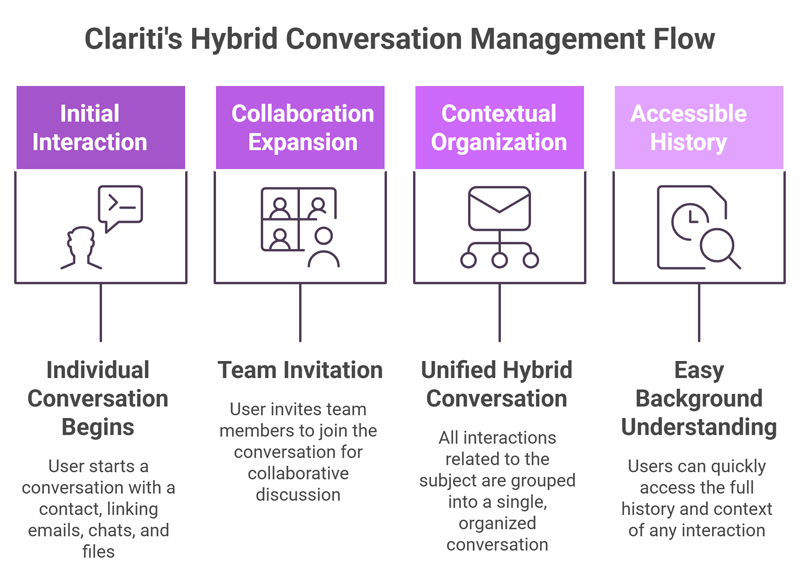
Because conversations remain contextual, Clariti naturally supports both individual relationship management and team collaboration.
Professionals can begin managing interactions on their own—much like using a personal CRM—and later expand those conversations to include team members when necessary.
This ability to transition smoothly from personal communication to team collaboration makes Clariti a powerful tool for modern workplaces.
Case Study: Turning Personal Relationship Management into Team Collaboration with Clariti
Problem Statement
Professionals working in modern organizations often juggle communication with both internal team members and external clients. Emails, chats, meetings, and files are typically spread across multiple tools, making it difficult to maintain a clear and complete view of conversations.
This challenge becomes even more noticeable when a discussion that initially starts as a private interaction with a client later needs input from other team members. In most cases, the process involves forwarding long email threads, explaining previous discussions, and sharing documents separately. This not only wastes time but also increases the chances of missing important context.
Many professionals also face another dilemma: not every conversation needs to involve the team immediately. Sometimes discussions with clients start as one-to-one interactions and only later require internal collaboration.
What they need is a system that allows them to manage conversations privately when necessary and seamlessly involve their team at the right moment without losing context.
Managing Internal and External Conversations in One Place
In a typical workday, a professional might communicate with external clients through email while simultaneously collaborating with colleagues through chat and meetings. Clariti simplifies this by bringing emails, chats, calendar events, and files into one unified workspace.
When communicating with external clients via email, every interaction automatically becomes part of a contextual conversation. This means that emails are not isolated messages in an inbox but are instead linked to the relevant subject and contact.
At the same time, internal discussions with colleagues can happen through chat within the same platform. Because everything exists in the same environment, users can easily switch between client communication and internal collaboration without jumping between multiple tools.
Maintaining Private One-to-One Client Conversations
Often, professionals need to maintain private communication with a client during the early stages of a discussion. This could involve clarifying requirements, negotiating details, or exchanging preliminary information before involving the rest of the team.
Clariti allows users to handle these one-to-one email conversations privately while still organizing them under a clear subject. This ensures that the entire conversation history is preserved and easy to revisit later.
During this phase, the professional can:
- Communicate directly with the client via email.
- Attach files or documents related to the discussion.
- Schedule meetings using the built-in calendar.
- Create reminders or to-dos for follow-ups.
All these interactions remain connected within the same contextual conversation, effectively allowing the user to manage the relationship as a personal CRM.
Bringing the Team into the Conversation at the Right Time
As the discussion progresses, there often comes a point where input from other team members becomes necessary. Traditionally, this would involve forwarding multiple emails or summarizing the entire discussion manually. Clariti removes this friction through its Chat from Email feature.
With a single click, the user can start an internal chat directly from the existing email conversation and invite relevant team members to join. Once the team members are added, they instantly gain access to the entire history of the interaction.
This includes:
- Previous email conversations with the client.
- Files and documents that were shared.
- Notes and meeting details related to the subject.
Because everything is already connected within the same conversation, team members do not need additional explanations to understand what has happened so far.
Giving the Team the Full Context
One of the biggest advantages of this approach is that new participants enter the conversation with complete context.
Instead of asking questions like:
- “What did the client say earlier?”
- “Which document are we referring to?”
- “What was agreed in the last meeting?”
Team members can simply review the conversation thread to see the full background. This significantly reduces miscommunication and helps everyone align quickly on the next steps.
From that point onward, the conversation evolves naturally into a collaborative team discussion where both internal and external communication remain connected.
Benefits of Using Clariti as Both a Personal and Team CRM
Using Clariti as both a personal and team CRM offers several advantages for professionals and organizations managing complex communication and relationships.
Unified communication workspace
Emails, chats, files, and meetings remain connected in one place, eliminating the need to search across multiple tools.
Complete conversation history
Every email, document, and discussion stays linked within a single contextual conversation, giving users a clear record of all interactions.
Flexible privacy and collaboration
Conversations can begin as private one-to-one interactions and later expand to include team members when collaboration is required.
Better relationship visibility
Users can easily view the full history of interactions with contacts, helping them maintain meaningful and consistent communication.
Reduced context switching and manual work
There is no need to switch between platforms, forward long email threads, or manually summarize previous discussions.
Improved team alignment and decision-making
When colleagues join a conversation, they instantly see the complete background, enabling faster understanding and more informed responses.
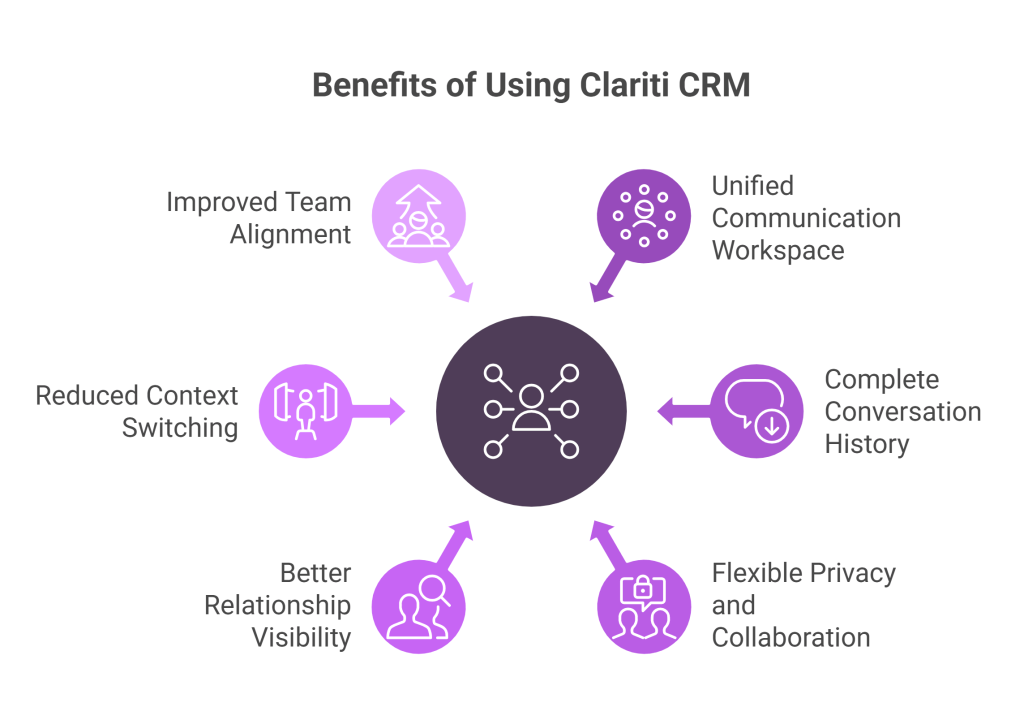
By bringing communication and relationship management into a single contextual workspace, Clariti helps professionals maintain stronger connections while enabling teams to collaborate more efficiently.
The Result
By allowing professionals to start conversations privately and expand them into team collaborations when needed, Clariti bridges the gap between personal relationship management and team-based CRM.
This ensures that communication remains organized, contextual, and accessible to the right people at the right time—ultimately enabling teams to respond faster, collaborate better, and maintain stronger client relationships.
Going beyond traditional CRM
As workplaces become more connected and collaborative, the way professionals manage relationships is also evolving. Traditional communication tools often separate conversations across emails, chats, files, and meetings, making it difficult to maintain a clear understanding of interactions and commitments.
At the same time, many CRM platforms are designed primarily for sales teams and structured pipelines, which may not suit professionals who simply want a better way to manage conversations and relationships. The future of relationship management lies in solutions that combine personal organization with team collaboration. Professionals need tools that allow them to manage their individual communication effectively while also enabling teams to step in when collaboration becomes necessary.
This is where contextual communication platforms play a significant role. By organizing emails, chats, calendar events, and files around a shared subject, contextual collaboration tools ensure that conversations remain connected and meaningful. Instead of searching across multiple applications, professionals can view the full story behind any interaction in one place.
When professionals have access to the full history of their conversations, commitments, and collaborations, they can engage with greater clarity and confidence. This not only strengthens relationships but also helps organizations respond more effectively to clients and partners.
Clariti brings this vision to life by bridging the gap between personal CRM and team CRM. By combining contextual communication with flexible collaboration, Clariti enables professionals and teams to manage relationships more intelligently. Individuals can start by managing conversations and contacts privately, just as they would with a personal relationship management system. When the situation requires teamwork, those same conversations can easily expand to include colleagues without losing any prior context.
In a world where connections often shape opportunities, having the right system to nurture those relationships makes all the difference. Because ultimately, your network truly is your net worth.
Frequently Asked Questions
What does “your network is your net worth” mean in business?
It means the value of your professional relationships directly impacts opportunities, growth, and success. Strong networks help generate leads, partnerships, and long-term business outcomes.
How can Clariti function as a personal CRM?
Clariti organizes emails, chats, files, and interactions into context-rich conversations, making it easy to track relationships, follow-ups, and communication history with individual contacts.
How does Clariti work as a team CRM?
Clariti allows teams to share communication context, track customer interactions, and collaborate in one platform, ensuring everyone has visibility into conversations and relationship status.
What makes Clariti different from traditional CRM tools?
Unlike traditional CRMs that require manual data entry, Clariti automatically organizes communication into conversations, reducing effort and improving real-time collaboration.
Can small teams use Clariti as a CRM alternative?
Yes, small teams can use Clariti as a lightweight CRM to manage contacts, communication, and follow-ups without the complexity and cost of traditional CRM systems.
How does Clariti improve relationship management?
By keeping all interactions—emails, chats, calls, and files—in one place, Clariti ensures no context is lost, helping teams maintain stronger and more organized relationships.
Is Clariti suitable for managing client communication?
Yes, Clariti integrates email and internal communication, allowing teams to manage client conversations, track discussions, and respond efficiently without switching tools.
How does contextual communication help in CRM?
Contextual communication links all related interactions, making it easier to understand history, reduce miscommunication, and improve decision-making in relationship management.
Can Clariti replace a full CRM system?
For small and mid-sized teams, Clariti can replace basic CRM needs by handling communication, follow-ups, and collaboration, though advanced sales pipelines may require dedicated CRM tools.
How do teams get started with Clariti as a CRM?
Start by organizing contacts into conversations, integrating email accounts, and using shared threads to track interactions. Gradually adopt it for managing all relationship-driven communication.




Start for FREE with Personal CRM
We too hate spam! Your email is secure with us.

Spot secured. You're in.
You’re officially on the list for early access to Clariti.


No more switching tools.

No more lost context.

Just Clarity.
You’ll be among the first to experience it when we launch. We’ll let you know the moment it’s ready.

Keep an eye out for emails from @clariti.app.
(and check your spam folder just in case—whitelisting us helps ensure you don’t miss a thing).