

Communication Concepts for Modern Teams
Clear communication starts with shared understanding. These concepts explain how context, topics, and AI-powered conversations help teams communicate with clarity, continuity, and purpose-across chats, emails, meetings, and files.
What Is Frontline Communication?
Definition, Benefits & Modern Approach
Frontline communication refers to the structured flow of information between customer-facing employees and the broader organization. It ensures that service representatives, field teams, and operational staff have complete, accurate, and timely context when interacting with customers.
In modern digital environments, frontline communication is no longer limited to message delivery. It involves contextual continuity, historical visibility, and coordinated collaboration across departments.
The Structural Challenge of Frontline Teams
Frontline employees often face:
- Scattered customer communication across email and chat.
- Limited visibility into prior discussions.
- Dependency on internal follow-ups for clarification.
- Repetition of information across departments.
- Delays caused by fragmented systems.
When context is missing, service quality and response speed decline.
What Defines Effective Frontline Communication?
Effective frontline communication includes:
- Complete customer interaction history.
- Internal collaboration within the same context.
- Immediate access to related documents.
- Visibility into previous decisions.
- Clear alignment between departments.
It transforms customer engagement from reactive response into informed interaction.
Frontline Communication vs Traditional Internal Messaging
|
Traditional Messaging
|
Context-Rich Frontline Communication
|
|---|---|
The difference lies in continuity and structural integration.
Frontline Communication in Practice
In a context-based communication system such as Clariti, frontline teams access unified conversations that combine customer emails, internal discussions, shared files, and calendar events within a single subject.
For example:
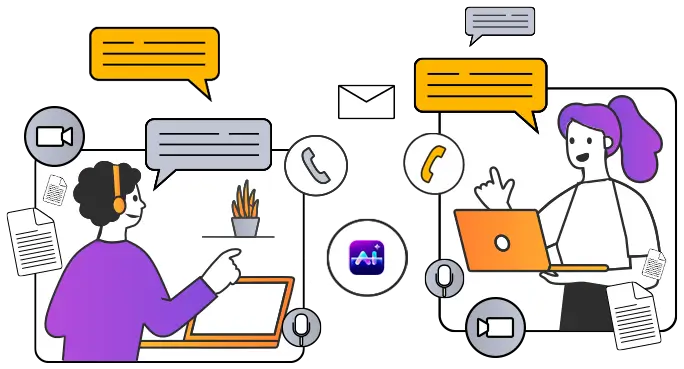
A support request may begin with a customer email. Internal teams discuss solutions via chat within the same conversation. Relevant documentation is attached. A follow-up call is scheduled and recorded in context. Every interaction remains connected under one structured thread of meaning.
This reduces repetition and accelerates resolution.
The Role of AI in Frontline Communication
Artificial intelligence strengthens frontline communication by:
- Automatically linking related interactions.
- Identifying recurring issues across conversations.
- Preserving historical customer context.
- Supporting faster contextual search.
- Reducing dependency on manual tagging.
AI enables continuity without increasing operational complexity.
Benefits for Customer Experience
When frontline teams operate within a structured communication environment:
- Response times decrease.
- Resolution accuracy improves.
- Context switching reduces.
- Customer frustration declines.
- Service consistency increases.
Frontline employees shift from information gathering to solution delivery.
Benefits for Internal Operations
Internally, context-rich frontline communication:
- educes duplicated effort.
- Improves cross-department coordination.
- Preserves knowledge for future cases.
- Accelerates onboarding for new employees.
- Strengthens accountability.
Operational clarity improves alongside customer satisfaction.
Frontline Communication in Distributed Teams
In distributed or hybrid work environments, frontline employees may be remote from internal teams. A unified communication structure ensures that:
- Customer discussions remain visible to all stakeholders.
- Internal decision-making stays connected to customer context.
- Remote coordination does not disrupt continuity.
- Escalations retain full communication history.
This supports consistent service regardless of location.
Common Misconceptions
Frontline communication is not:
- Only customer messaging.
- A CRM replacement.
- Limited to call centers.
- Just internal team chat.
It is a structured approach to maintaining full context across customer-facing interactions.
Closing Perspective
Frontline communication represents a structural shift in how organizations support customer-facing employees. By preserving full context across emails, chat, documents, and meetings, teams respond with clarity rather than fragmentation.
The result is not merely faster communication—but more informed, consistent, and scalable service delivery.
Frequently Asked Questions
What is frontline communication?
Frontline communication is the structured flow of contextual information between customer-facing employees and the broader organization.
Why is frontline communication important?
It improves response accuracy, reduces repetition, and enhances customer experience.
How does AI improve frontline communication?
AI automatically connects related interactions and preserves communication history.
Is frontline communication only for support teams?
No. It applies to sales, operations, field service, and any customer-facing role.
How does structured communication benefit customers?
Customers receive faster, more informed responses with less need to repeat information.

Start for FREE with Personal CRM
We too hate spam! Your email is secure with us.

Spot secured. You're in.


No more switching tools.

No more lost context.

Just Clarity.

Keep an eye out for emails from @clariti.app.
(and check your spam folder just in case—whitelisting us helps ensure you don’t miss a thing).