
Communication Concepts for Modern Teams
Clear communication starts with shared understanding. These concepts explain how context, topics, and AI-powered conversations help teams communicate with clarity, continuity, and purpose-across chats, emails, meetings, and files.
What Is AI Team Communication?
Definition, Benefits & Examples
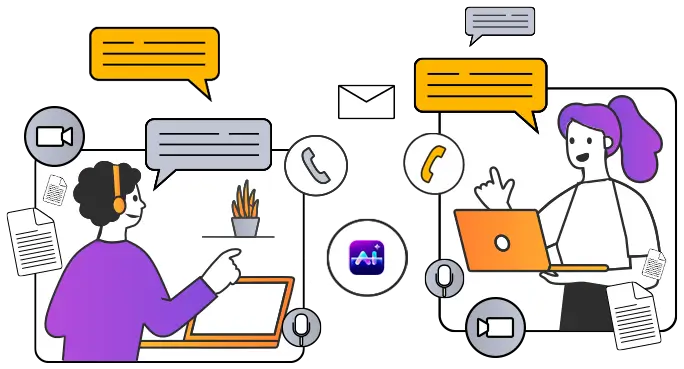
AI team communication refers to the use of artificial intelligence to enhance how teams exchange information, coordinate work, and make decisions. Instead of merely delivering messages, AI-supported systems analyze patterns, preserve context, prioritize signals, and reduce communication overload.
In modern workplaces, AI team communication strengthens collaboration by improving clarity, minimizing fragmentation, and supporting more efficient coordination across distributed environments.
Why Traditional Team Communication Struggles at Scale
As organizations grow, communication complexity increases due to:
- High message volume.
- Multiple communication channels.
- Distributed teams.
- Cross-functional collaboration.
Traditional tools focus primarily on message delivery rather than communication intelligence. As a result, teams often face:
- Information overload.
- Missed priorities.
- Repeated clarifications.
- Decision delays.
AI team communication addresses these structural inefficiencies.
What AI Adds to Team Communication
AI enhances team communication in several ways:
- Identifying important messages among high-volume exchanges.
- Detecting recurring themes and subjects.
- Associating new interactions with ongoing discussions.
- Highlighting relevant documents and prior decisions.
- Reducing redundant communication.
Rather than replacing human interaction, AI functions as a coordination layer that improves signal clarity.
AI Team Communication vs Traditional Communication Tools
Traditional tools provide:
- Message transmission.
- Basic search functionality.
- Thread-based replies.
AI-enhanced systems provide:
- Context awareness.
- Intelligent prioritization.
- Subject continuity across channels.
- Pattern recognition.
- Automated organization.
The difference lies in intelligence depth. AI team communication emphasizes meaning preservation and relevance rather than message flow alone.
AI Team Communication in Practice
A practical implementation of AI team communication can be observed in platforms such as Clariti. Instead of isolating emails, chats, and meetings, Clariti uses AI to connect related interactions into unified, topic-based conversations. The system continuously learns from communication patterns, helping teams maintain continuity, reduce noise, and focus on relevant discussions without manual sorting.
Core Capabilities of AI Team Communication
AI-driven communication systems typically support:
- Context detection across communication formats.
- Automatic conversation grouping by subject.
- Relevance-based message surfacing.
- Intelligent search based on meaning.
- Continuity preservation over time.
These capabilities reduce cognitive burden while strengthening coordination.
AI Team Communication in Distributed Work Environments
In remote and hybrid workplaces, asynchronous communication increases the risk of misalignment. AI team communication supports distributed collaboration by:
- Preserving full discussion history.
- Highlighting relevant prior exchanges.
- Enabling rapid onboarding into ongoing conversations.
- Reducing the need for repetitive meetings.
This structure improves clarity without requiring constant real-time interaction.
Impact on Productivity and Decision-Making
When AI enhances team communication:
- Time spent searching for information decreases.
- Important messages are less likely to be overlooked.
- Decision rationale remains visible.
- Communication redundancy declines.
Over time, AI-supported collaboration transforms communication from reactive exchanges into structured knowledge systems.
How AI Reduces Communication Overload
Communication overload occurs when the volume of messages exceeds a team’s ability to process them effectively. AI mitigates this by:
- Filtering low-relevance signals.
- Connecting related discussions.
- Maintaining subject continuity.
- Supporting intelligent search.
By prioritizing meaning over volume, AI helps teams focus on essential information.
Common Misconceptions About AI Team Communication
AI team communication is not:
- Automated message generation without oversight.
- Replacement for human collaboration.
- A surveillance mechanism.
- A fully autonomous decision-maker.
It functions as a support layer that enhances clarity and reduces fragmentation.
Practical Examples
Customer support teams benefit when AI connects related customer interactions across email and internal chat.
Product development teams use AI to maintain continuity across long-running design discussions.
Sales teams rely on AI to surface relevant prior negotiations and stakeholder communications during deal cycles.
In each case, AI improves signal clarity and reduces coordination effort.
Closing Perspective
AI team communication represents a structural evolution in workplace collaboration. As message volume and channel diversity increase, intelligence-driven systems become essential for maintaining clarity and continuity. By reducing overload, preserving context, and strengthening coordination, AI transforms fragmented exchanges into organized, meaningful collaboration.
Frequently Asked Questions
What is AI team communication?
AI team communication uses artificial intelligence to enhance clarity, prioritization, and continuity in workplace collaboration.
How does AI improve team communication?
AI detects related subjects, prioritizes relevant messages, and preserves context across communication channels.
Does AI replace human communication?
No. It enhances coordination and reduces manual effort while keeping humans in control.
Why is AI team communication important for remote teams?
It preserves context and reduces overload in asynchronous, distributed environments.
Is AI team communication secure?
Security depends on the platform implementation, but enterprise-grade systems apply privacy and compliance controls.

Start for FREE with Personal CRM
We too hate spam! Your email is secure with us.

Spot secured. You're in.


No more switching tools.

No more lost context.

Just Clarity.

Keep an eye out for emails from @clariti.app.
(and check your spam folder just in case—whitelisting us helps ensure you don’t miss a thing).