

Communication Concepts for Modern Teams
Clear communication starts with shared understanding. These concepts explain how context, topics, and AI-powered conversations help teams communicate with clarity, continuity, and purpose-across chats, emails, meetings, and files.
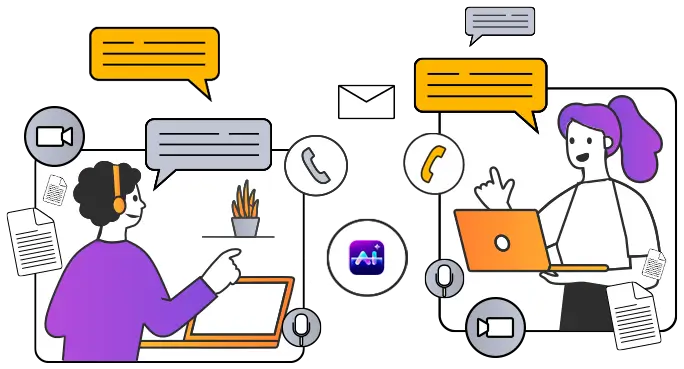
What Is AI Context Preservation?
Definition, Benefits & Examples
AI context preservation is the use of artificial intelligence to automatically maintain the background, relationships, and continuity behind workplace communication. It ensures that emails, chat messages, files, and meetings remain connected to their relevant subjects without requiring manual organization.
In modern organizations, AI context preservation reduces fragmentation, prevents information loss, and strengthens long-term knowledge retention across distributed teams.
Why Manual Context Preservation Fails at Scale
As communication volume increases, maintaining context manually becomes impractical. Teams frequently experience:
- Cross-channel fragmentation.
- High message velocity.
- Participant turnover.
- Long-running discussions across weeks or months.
When context depends on human memory or manual tagging, continuity breaks down. Important details become buried, and decision rationale becomes difficult to trace.
AI context preservation addresses this scalability challenge.
What AI Context Preservation Actually Means
AI context preservation involves systems that:
- Identify related interactions across communication channels.
- Detect thematic similarity and recurring subjects.
- Associate new messages with existing conversations.
- Maintain chronological and logical continuity.
Instead of relying on users to organize discussions, the system continuously observes patterns and maintains structural cohesion automatically.
AI Context Preservation vs Traditional Organization
Traditional communication organization relies on:
- Manual folders.
- Email threads.
- Chat channels.
- User-created tags.
These methods require active user effort and often fail when discussions move across platforms.
AI context preservation differs because:
- Organization is automated.
- Context linking spans multiple formats.
- Subject continuity persists over time.
- Human intervention is minimized.
The distinction lies in intelligence-driven continuity rather than user-driven categorization.
AI Context Preservation in Practice
A practical implementation of AI context preservation can be observed in platforms such as Clariti. Instead of requiring users to manually group communication, Clariti uses AI to identify related emails, chat discussions, files, and calendar events and associate them within a unified, topic-based conversation. This ensures that the full “who, what, when, and why” behind each subject remains intact as communication evolves.
How AI Preserves Context Step by Step
AI-driven systems typically preserve context through:
- Natural language processing to detect subject similarity.
- Participant analysis to identify recurring collaborators.
- Timeline analysis to maintain chronological flow.
- Continuous learning to refine associations over time.
This process allows communication continuity to strengthen automatically as interactions accumulate.
AI Context Preservation in Asynchronous Work
In distributed teams, conversations often extend across days or weeks. Without preserved context, participants must repeatedly reconstruct background information.
AI context preservation allows team members to:
- Re-enter discussions with full visibility.
- Understand prior decisions instantly.
- Review supporting documents without searching multiple tools.
- Contribute without requiring synchronous clarification.
This supports efficient collaboration across time zones.
Impact on Productivity and Cognitive Load
When AI maintains context automatically:
- Search time decreases.
- Decision traceability improves.
- Redundant explanations are reduced.
- Cognitive load declines.
Employees spend less time reconstructing conversations and more time progressing work. Over time, communication becomes a structured knowledge system rather than fragmented exchanges.
How AI Strengthens Institutional Memory
Each preserved interaction adds contextual depth to a subject. As projects evolve, AI continues to:
- Connect new information to historical decisions.
- Maintain rationale visibility.
- Preserve accountability trails.
This compounding effect enhances organizational memory and reduces dependency on individual recollection.
Common Misconceptions About AI Context Preservation
AI context preservation is not:
- Surveillance of communication behavior.
- Replacement of human judgment.
- Automatic decision-making.
- Additional administrative work.
It functions as a structural continuity layer, maintaining relationships between interactions to reduce ambiguity.
Practical Examples
Customer support teams benefit when AI connects prior customer emails, internal coordination, and resolution updates within one subject.
Product teams rely on AI to maintain continuity across long development cycles involving multiple communication formats.
Sales teams use preserved context to track evolving negotiations, stakeholder discussions, and documentation over extended periods.
In each case, AI reduces reconstruction effort and strengthens clarity.
Closing Perspective
AI context preservation addresses a structural challenge in modern work: maintaining continuity as communication becomes multi-channel, asynchronous, and high-volume. By automatically connecting related interactions and preserving meaning over time, organizations reduce cognitive overload, strengthen collaboration, and transform communication into a durable, scalable knowledge system.
Frequently Asked Questions
What is AI context preservation?
AI context preservation is the automatic maintenance of communication background and relationships across channels using artificial intelligence.
How does AI preserve communication context?
AI detects related subjects, associates new interactions with existing discussions, and maintains chronological continuity.
Why is AI context preservation important?
It reduces fragmentation, prevents information loss, and improves decision traceability in multi-channel workplaces.
Does AI context preservation replace human organization?
No. It supports and enhances organization by reducing manual effort.
Is AI context preservation only useful for remote teams?
No. While especially valuable in distributed environments, it benefits any team handling high communication volume.

Start for FREE with Personal CRM
We too hate spam! Your email is secure with us.

Spot secured. You're in.


No more switching tools.

No more lost context.

Just Clarity.

Keep an eye out for emails from @clariti.app.
(and check your spam folder just in case—whitelisting us helps ensure you don’t miss a thing).