

Communication Concepts for Modern Teams
Clear communication starts with shared understanding. These concepts explain how context, topics, and AI-powered conversations help teams communicate with clarity, continuity, and purpose-across chats, emails, meetings, and files.
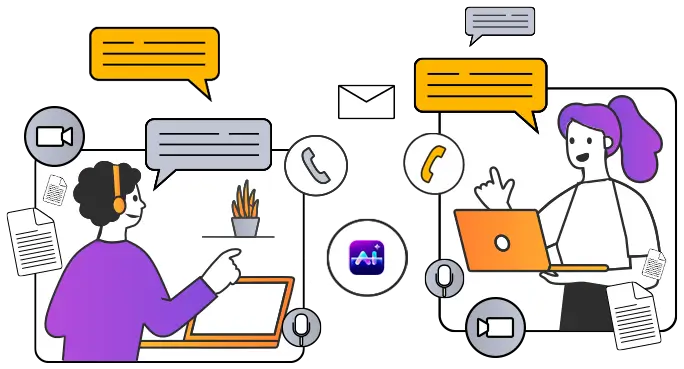
What Is Contextual Communication?
Definition, Benefits & Examples
Contextual communication is an approach to workplace communication where messages are understood together with their surrounding background—specifically who said what, when it was said, and why it matters. Instead of treating emails, chat messages, meetings, and shared files as isolated events, contextual communication connects all related interactions into a continuous, meaningful conversation around a specific subject.
In modern organizations, contextual communication helps teams retain clarity, reduce repetition, and make better decisions by preserving the full history and intent behind discussions over time.
The Evolution of Workplace Communication
Workplace communication has evolved significantly over the past few decades. Early collaboration relied on in-person conversations and shared physical documents, where context was naturally present. As organizations adopted email, communication became asynchronous but still relatively linear, with discussion history preserved in message threads.
The rise of real-time chat tools accelerated communication but introduced fragmentation. Conversations became distributed across multiple channels, private messages, email inboxes, meetings, and file-sharing platforms. While speed increased, continuity declined. Important background information was often lost as discussions moved between tools or were interrupted by time gaps.
Contextual communication emerged as a response to this fragmentation, aiming to restore continuity by organizing communication around subjects rather than channels.
What Does “Context” Mean in Workplace Communication?
In a work environment, context refers to the information that gives meaning to a message. This typically includes:
- Who is involved in the discussion.
- What is being discussed or decided.
- When the communication occurred in relation to previous interactions.
- Why the message exists, including its purpose and relevance.
Without this background, messages can be misinterpreted, decisions can appear unclear, and new participants may struggle to understand ongoing work.
Contextual communication ensures that these elements remain visible and connected, allowing participants to understand not just the content of a message, but its significance within a broader discussion.
How Context Gets Lost in Modern Teams
Despite having access to multiple communication tools, many teams struggle to maintain context. Common causes include:
- Channel silos, where discussions are split across chat, email, and meetings.
- Time gaps, especially in asynchronous or distributed teams.
- Participant changes, when new team members join without a full background.
- Message volume, where important information is buried under newer messages.
Over time, teams compensate by repeating explanations, forwarding emails, or scheduling meetings simply to re-establish shared understanding. These workarounds increase overhead and reduce productivity.
Contextual Communication vs Traditional Messaging
Traditional messaging systems focus on message delivery rather than continuity. Emails are organized by inboxes and threads, while chat tools prioritize real-time streams. In both cases, the structure emphasizes chronology or immediacy rather than subject continuity.
Contextual communication, by contrast, treats a conversation as a long-lived entity. Messages are grouped by topic, and related interactions—such as documents, meetings, and decisions—are connected to the same subject. This allows conversations to remain intelligible even after long pauses or participant changes.
The difference is not about speed, but about meaning preservation.
Contextual Communication in Practice
One practical example of contextual communication can be seen in platforms such as Clariti. Instead of organizing communication by individual channels like chat or email, Clariti groups related messages, emails, calendar events, and shared files by subject. This approach helps teams retain the full “who said what, when, and why” behind ongoing discussions, even as conversations span multiple formats and participants.
How Contextual Communication Works in Practice
In a contextual communication model, work revolves around clearly defined subjects or topics. Every interaction related to a subject is associated with that topic, regardless of the communication channel used.
For example, a product issue may include:
- Initial customer emails.
- Internal chat discussions.
- A scheduled meeting.
- Shared documents or screenshots.
- Follow-up decisions.
Instead of being scattered, these interactions are viewed together as part of a single conversation. Team members can review the full history at any time and understand how the discussion evolved.
The Role of AI in Preserving Communication Context
Maintaining context manually becomes increasingly difficult as communication volume grows. This is where artificial intelligence plays an important role.
AI-driven systems can:
- Identify related messages across channels.
- Detect recurring subjects and themes.
- Automatically associate new interactions with existing conversations.
- Maintain chronological and logical continuity.
By continuously observing communication patterns, AI helps preserve context without requiring users to change how they communicate. This reduces the cognitive load on individuals while improving clarity at the team level.
Contextual Communication in Asynchronous and Distributed Work
Asynchronous work environments rely heavily on written communication and delayed responses. While this flexibility is beneficial, it increases the risk of context loss, especially when conversations span days or weeks.
Contextual communication supports asynchronous work by ensuring that each participant can re-enter a discussion with full background information. Instead of relying on real-time explanations or repeated summaries, team members can review the complete conversation history and proceed with confidence.
This capability is particularly important for distributed teams operating across time zones.
Impact on Productivity and Decision-Making
When context is preserved, teams spend less time searching for information, clarifying intent, or revisiting past decisions. This leads to:
- Faster onboarding into ongoing discussions.
- Reduced duplication of work.
- More informed decision-making.
- Fewer interruptions and follow-up messages.
Over time, contextual communication contributes to higher productivity by turning communication history into a usable knowledge asset rather than a fragmented record.
How Context Compounds Over Time
One of the key advantages of contextual communication is that its value increases over time. Each interaction adds to the collective understanding of a subject, making future discussions more efficient.
Long-running conversations become repositories of decisions, rationale, and outcomes. Instead of starting from scratch, teams build upon prior knowledge, enabling continuity even as projects evolve or team composition changes.
Common Misconceptions About Contextual Communication
Contextual communication is often misunderstood. It is not:
- Merely storing message history.
- Creating more documentation.
- Adding complexity to communication.
- Slowing down real-time collaboration.
Instead, it simplifies communication by reducing the effort required to reconstruct understanding. The goal is clarity, not volume.
Practical Examples of Contextual Communication
- Customer support teams use contextual communication to view all prior interactions with a customer before responding.
- Sales teams maintain context across long sales cycles involving multiple stakeholders.
- Internal teams track project discussions, decisions, and documents within a single conversation rather than across tools.
In each case, context reduces friction and improves outcomes.
Closing Perspective
Contextual communication addresses a fundamental challenge of modern work: preserving meaning as communication becomes faster, more distributed, and more complex. By focusing on continuity rather than messages alone, teams can collaborate with greater clarity, efficiency, and confidence.
Frequently Asked Questions
What is a communication context?
Communication context is the background information that explains a message, including participants, timing, purpose, and related history.
How is contextual communication different from chat-based communication?
Chat-based communication focuses on message streams, while contextual communication preserves subject-based continuity over time.
Why is contextual communication important for remote teams?
Remote teams depend on asynchronous work. Contextual communication ensures clarity without constant real-time interaction.
Does contextual communication replace real-time chat?
No. It complements real-time communication by preserving meaning and continuity beyond immediate exchanges.
How does AI support contextual communication?
AI helps identify, connect, and maintain relationships between related communications automatically.

Start for FREE with Personal CRM
We too hate spam! Your email is secure with us.

Spot secured. You're in.


No more switching tools.

No more lost context.

Just Clarity.

Keep an eye out for emails from @clariti.app.
(and check your spam folder just in case—whitelisting us helps ensure you don’t miss a thing).