




Blog Summary
Sales teams don’t lose deals because they respond slowly; they lose them because clarity takes too long to assemble. Reps spend nearly 30% of their day searching across email, chat, CRM, and meeting notes, turning response time into a coordination problem rather than a performance one. Clariti addresses this by organizing communication around hybrid conversations, where customer emails, internal discussions, decisions, tasks, and follow-ups live together. The result isn’t just faster replies, but more confident ones the kind buyer's trust.
Customer response time improves sustainably when context has a single home - because speed is not an effort issue, it’s a system outcome.
- Speed is a buying signal, not a service metric - 78% of buyers choose the vendor that responds first.
- Response time breaks when context is scattered - context switching costs teams up to 23 minutes per interruption.
- Shared context drives confident replies - unified workflows improve response time by 20–25%.
Key takeaway:Buyers read silence as uncertainty, not patience. When context has one home, speed becomes automatic not a performance metric, but a system advantage.
View more
Every revenue leader knows the stakes: companies that respond to new leads within an hour are almost seven times more likely to qualify them than those that wait longer, according to Harvard Business Review. Yet in many teams we’ve observed, even the most motivated reps watch their customer response time slip-not because they’re slow, but because their context is scattered.
Emails live in one place, internal answers in another, decisions in yet another. By the time a clear, aligned response is ready, the moment of opportunity has passed.
We’ve watched Clariti for sales teams change that dynamic by giving internal and external collaboration a single home. It doesn’t just promise “faster replies”; it restructures how conversations are organized so that confidence comes first and speed follows naturally.
This article looks at what actually breaks response time, how Clariti was shaped by what we noticed in the field, and how one company used a hybrid chat-email sales workflow to cut response times by 35%-without burning out the team.
Why Customer Response Time Really Breaks Down
When leaders ask how to improve customer service response time, the answers often focus on individual behavior: better inbox hygiene, more templates, stricter SLAs. What we kept noticing was that the real friction lived elsewhere.
In dozens of teams, similar patterns appeared:
- Frontline vs. backend split
Frontline teams (sales, support) live in email with customers. Backend teams (ops, tech, product) live in chat and internal tools. Every non-trivial question triggers a manual bridge between those worlds. - Copy-paste collaboration
Reps screenshot or forward customer emails into team chat for sales support, collect replies from specialists, then translate those back into email. Nuance is lost in each retelling.
- Managers as human routers
Leaders spend time connecting dots across systems-Gmail, Slack/Teams, project tools, CRM-instead of coaching deals.
We also saw the cost of this fragmentation show up in productivity. McKinsey’s research has long suggested that streamlining internal communication and collaboration can boost knowledge worker productivity by 20-25%. The inverse is also true: when context is scattered, time-to-answer quietly expands.
In that environment, “How can response time be improved?” is really a systems question, not a speed question.
How Clariti Was Designed for Sales Teams Facing Response Time Delays
After watching these patterns repeat, a few things became hard to ignore.
We saw:
- Frontline teams (sales, support) living almost entirely in customer email.
- Backend teams (ops, tech, product) operating in chat and internal project tools.
- Managers trying to knit everything together with screenshots, forwards, and extra meetings.
The pain wasn’t that people weren’t collaborating.
It’s that collaboration had no single workspace.
At the same time, customer expectations were rising. Salesforce’s State of Sales report notes that 66% of customers expect companies to understand their needs and expectations. That kind of understanding is nearly impossible when half the story sits in inboxes and the other half in internal chats.
Clariti was built as an AI-powered communication platform to give that collaboration a home-not as another chat app or another inbox, but as a context-based hybrid conversation.
In practice, that looks like:
- Hybrid Conversations
Emails, chats, files, calls, to-dos, and calendar events are pulled into one shared thread per topic-such as a customer, deal, or issue. - Contextual Email Embedding
Frontline teams drop full customer emails directly into internal hybrid conversations. No forwarding, no copy-paste, no missing details. - AI-Powered Sorting
New messages are auto-suggested into the right conversation, so the history of a deal stays intact rather than splintering across threads. - To-do & Calendar Inside the Conversation
“Get security review from IT” becomes a task in the same place the conversation happens; follow-up calls or demos are scheduled from the same conversation chain.

We watched this structure quietly transform how Clariti for sales teams handled responses-especially when multiple stakeholders were involved and the stakes were high.
How to Improve Customer Service Response Time Without Burning People Out
In the environments we observed, the most effective answer to how to improve customer service response time was surprisingly simple:
Reduce the number of internal steps required before a rep can confidently hit “send.”
Instead of pushing people to type faster, the focus shifted to removing friction:
- Sales embeds the customer’s email into a hybrid conversation.
- Internal experts respond in that same space, with full visibility into context.
- To-dos/Tasks and calendar events are created in-line, so nothing escapes the narrative.
Gallup’s research has consistently tied employee engagement to clarity and reduced friction in everyday work. We saw that play out: when teams weren’t constantly reconstructing context, they were more engaged-and their responses were both faster and more accurate.
Clariti for sales teams works here not as a faster customer support tool in isolation, but as the environment where alignment happens before the customer ever sees a reply.
How Sales Teams Can Use Clariti to Improve Customer Response Time in Real Life (A 35% Faster Story)
One mid-sized B2C company we came across illustrated this shift clearly.
Before Clariti:
- Sales handled all customer communication via email.
- Ops, tech, and product lived in internal chat and project tools.
- Any meaningful customer question required copy-pasting, forwarding, or spinning up “quick calls.”
The consequences were familiar:
- Details got lost moving from inbox to chat and back.
- Response times ballooned while reps “collected input.”
- New hires had no searchable history explaining why certain decisions were made.
Enter Clariti.
The team re-architected around hybrid conversations:
- Every significant customer thread became a hybrid conversation in Clariti.
- Reps embedded customer emails directly into those threads-eliminating forwarding chains and “per my last email” archaeology.
- Team chat for sales support moved into those same conversations. Instead of pinging a generic channel, reps asked questions in the context of that customer.
Support, ops, and tech could see the full email history before weighing in. Their answers were grounded in what had already been promised and discussed.
Decisions turned into actions instantly:
- Follow-ups, deadlines, and ownership were added as to-dos in the thread.
- Calendar events for demos or reviews were created inside the hybrid conversation, tied to the exact question and rationale.
Leaders gained end-to-end visibility:
- Managers could see where deals were stalling-clarification, approvals, or execution-without asking for recaps.
- Coaching shifted from “respond faster” to “here’s where context keeps breaking; let’s fix that upstream.”
The outcome:
- A 60% drop in communication gaps between frontline and backend teams
- 35% faster customer response times
- Faster onboarding for new reps, who could learn from searchable hybrid histories instead of piecing the past together from multiple tools
Those improvements aligned closely with what broader research predicts: faster, contextual responses tend to support higher conversion and more productive teams. But in this case, they came not from hiring more people, but from moving the work into one shared narrative (Context-based hybrid conversation) per customer.
Why Faster Customer Support Tools Alone Don’t Fix Response Time
We also saw teams that had invested heavily in faster customer support tools-macros, SLAs, chatbots-yet still struggled with slow, hesitant replies on complex issues.
The tools were fast; the alignment wasn’t:
- Chat yielded quick internal answers, but without complete customer history.
- Ticketing captured steps, but not the broader deal context.
- CRM held fields and amounts, but not the reasoning behind specific promises.
Teams were left asking how to increase response time without sacrificing accuracy, and repeatedly ran into the same trade-off: move fast and risk being wrong, or move slowly and be safe.
Clariti’s role in those stacks was not to replace existing systems, but to act as the connective layer that held the story-emails, chats, files, calls, and tasks-in one place. With that in place, speed and accuracy stopped being opposing forces.
The 4 P’s That Improve Customer Service - Reimagined for Sales
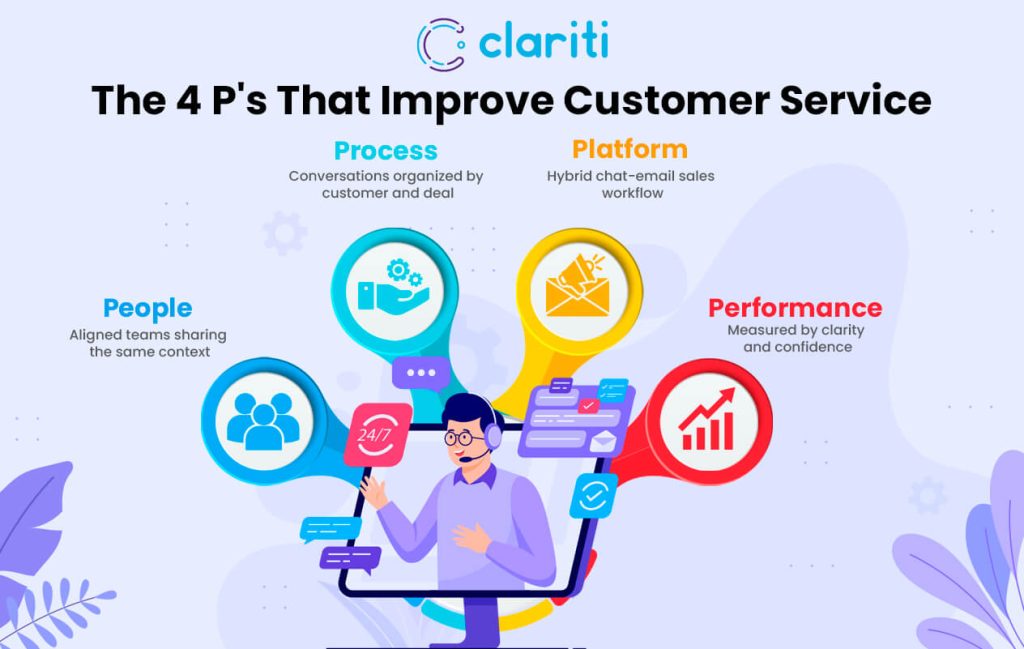
When leaders asked about the 4 P’s that improve customer service-traditionally People, Process, Product, Performance-we saw them resonate most when reframed through a systems lens for sales:
- People – Not just trained reps, but aligned teams sharing the same context.
- Process – Conversations organized by customer and deal, not by tool or channel.
- Platform – A hybrid chat-email sales workflow where internal and external communication share a single home.
- Performance – Measured not just by raw speed, but by the clarity and confidence of each response.
Clariti becomes the platform that holds these pieces together so they reinforce, rather than fight, each other.
Conclusion: Response Time Is a System Outcome
Across the teams we’ve observed, one pattern has held: customer response time doesn’t improve sustainably when organizations simply ask people to “go faster.”
It improves when:
- Internal and external conversations live in the same context.
- Multiple teams can contribute without re-creating the story from scratch.
- Collaboration has a clear home, instead of being spread thin across tools.
Clariti for sales teams was shaped to provide that home-a context-based workspace where hybrid conversations keep the full narrative in view. In that kind of environment, fast, confident responses stop being a heroic effort and become the natural outcome of how work gets done.
Frequently Asked Questions
How to improve customer service response time?
Start by making information easy to find. Keeps customer history, emails, and notes in one place. Set clear ownership so every request has a responsible person. Use simple templates for common questions. This cuts the time between seeing a request and sending a complete answer.
How to increase response time? (respond faster)
Shorten the path from question to context. Give teams a single view with emails, notes, and past decisions together. Create repeatable workflows for common issues, so people are not starting from zero. Set clear rules for discounts, approvals, and exceptions. This lets frontline teams answer quickly without waiting.
What are the 4 P's that improve customer service?
- People – Skilled, aligned team members
- Process – Simple, clear steps to handle requests
- Platform – Tools that keep all communication together
- Performance – Measuring both speed and quality
What causes slow customer response times?
Slow replies usually come from scattered information and unclear ownership. Teams search across email, chat, and tools to rebuild the story. Questions bounce between departments before anyone feels safe to answer. Decisions are not documented, so the same issues get re-opened. All of this adds hidden delay before a reply goes out.
What is a hybrid chat-email workflow in sales?
A hybrid chat-email workflow connects customer emails with internal chat in one place. The customer writes by email as usual. The sales team pulls that email into a shared space, talks about it with colleagues in chat, and decides what to do. Tasks and follow-ups are created from that same thread. The final answer then goes back to the customer by email, but the full context stays inside the team.




Start for FREE with Personal CRM
We too hate spam! Your email is secure with us.

Spot secured. You're in.
You’re officially on the list for early access to Clariti.


No more switching tools.

No more lost context.

Just Clarity.
You’ll be among the first to experience it when we launch. We’ll let you know the moment it’s ready.

Keep an eye out for emails from @clariti.app.
(and check your spam folder just in case—whitelisting us helps ensure you don’t miss a thing).