


Here’s a Tuesday morning reality check: Your star project manager just spent 18 minutes hunting for a client email that triggered three Slack conversations, two Google Drive links, and one “quick” Zoom call that nobody recorded.
Sound familiar?
We’ve created the most connected workplace in history. Yet somehow, we’re more disconnected than ever.
The culprit isn’t poor time management or lazy employees. It’s fragmented communication the invisible tax your team pays every day for using tools that don’t talk to each other.
According to RescueTime’s productivity research, knowledge workers check communication tools every 6 minutes. Every. Single. Day.
That’s not productivity. That’s digital whiplash.
What Is Fragmented Communication and Why It Happens?
Fragmented communication happens when one conversation gets scattered across multiple platforms with zero connecting tissue.
Picture this workflow:
- Client sends feedback via email
- You paste it into Slack for team discussion
- Someone shares a Google Doc response
- Another person schedules a Zoom to “align quickly”
- Tasks get created in three different tools
- Nobody remembers where the final decision lives
Each tool serves a purpose. Together, they create chaos.
Tool Overload Doesn't Equal Collaboration
Here’s the uncomfortable truth: We fragment communication in the name of “efficiency.”
Email for external clients. Slack for internal speed. Zoom for nuance. Notion for documentation.
It’s like hiring five translators for one conversation. Eventually, the message disappears entirely.
Emails, Chats, Calls - All Disconnected
When conversations jump between formats, context dies.
A client concern in email never reaches the developer in Slack. An urgent bug report gets buried while the team works on yesterday’s priorities.
The handoff becomes the breakdown.
Growth Without Structure Breeds Chaos
Fast-growing teams bolt new tools onto existing mess without considering integration.
“Just add Asana for project tracking.” “Try Monday.com for better visibility.”
“Maybe Notion will solve our documentation problem.”
What starts as solutions becomes the problem.
5 Hidden Costs of Fragmented Team Communication
The Time Sink of Context Switching
Research from UC Irvine shows it takes 23 minutes to fully refocus after an interruption.
Every time someone opens a new app to find related information, they’re paying the “switching tax” mental energy spent reconstructing context that should have been preserved.
Real cost: A 40-person team loses roughly 67 hours weekly to unnecessary context switching.
Missed Messages = Missed Revenue
When conversations scatter, critical information falls through digital cracks.
A client’s budget concern mentioned in email never reaches the sales team chatting in Slack. An urgent feature request gets buried in meeting notes while developers build the wrong thing.
Real cost: Salesforce research shows poor internal communication causes 67% of missed sales opportunities.
Frustrated Teams and Higher Turnover
Nothing burns out talented people faster than feeling constantly behind on conversations.
When team members spend more time searching for context than acting on it, frustration compounds. The cognitive load of managing six communication streams becomes exhausting.
Real cost: Gallup’s engagement data links poor communication directly to 12% higher turnover rates.
Leadership Blind Spots Lead to Bad Decisions
Executives can’t make informed choices without complete context.
When project discussions fragment across tools, leaders lose visibility into real blockers, team sentiment, and progress patterns.
Real cost: Decisions made with 70% of the information typically require 3x more resources to correct.
Security Risks Multiply Across Scattered Systems
Every communication tool creates another potential breach point.
Teams start sharing sensitive information through personal channels, using unsecured apps when corporate tools fail, or storing passwords in spreadsheets just to keep work moving.
Real cost: IBM’s data breach report shows distributed communication increases average breach costs by 23%.
What Context-Based Communication Really Looks Like
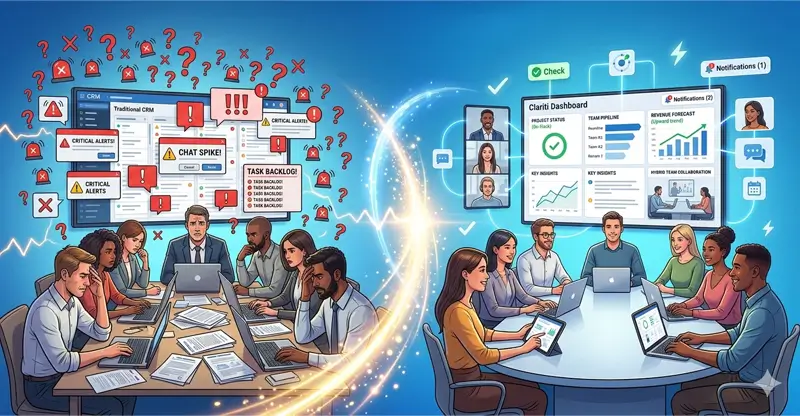
Here’s the shift: Instead of organizing by tool, organize by context.
Everything related to a project, client, or decision lives together regardless of whether it started as an email, chat, or video call.
One Place for All Related Conversations
Imagine dropping a client email directly into your team discussion. No forwarding. No copy-pasting. No context loss.
Backend teams can respond through chat while frontend teams add files. Everyone sees the complete picture without switching apps.
AI That Connects the Dots Automatically
Smart platforms use AI to suggest where new messages belong, automatically grouping related emails, chats, files, and tasks.
The technology handles organizational overhead so humans can focus on actual work.
Hybrid Conversations: Context Over Chaos
This isn’t about cramming everything into one overwhelming inbox.
It’s about creating context-based workspaces where conversations flow naturally between email, chat, files, and to-dos maintaining the communication style each person prefers while preserving shared context.
Think of it as conversation threads that actually make sense.
Clariti in Action: Real Results From Real Teams
From 90 Minutes of Daily Search to 15
The Challenge: A SaaS product manager was hunting for project context across seven different tools, spending 90 minutes daily just finding information.
The Solution: Context-based conversations that connected client emails with internal discussions and project files.
The Result: Search time dropped to 15 minutes. Team response time improved 35%. Fewer things fell through cracks.
Marketing Team Cuts Meetings by 40%
The Challenge: A distributed marketing team held daily sync meetings because nobody could track campaign progress across scattered conversations.
The Solution: Unified workspace giving everyone real-time visibility into campaign status, feedback, and deliverables.
The Result: Four daily meetings became two weekly check-ins. Team satisfaction increased. Campaign velocity improved.
IT Manager Eliminates "Where's That Link?" Forever
The Challenge: Constant interruptions asking about server documentation, error histories, and solution links scattered across tools.
The Solution: Embedded support emails directly into team conversations with searchable history.
The Result: Self-service rate increased 60%. Team interruptions decreased 70%. New hire onboarding accelerated.
How to Shift Your Team from Fragmented to Focused
Step 1: Audit Your Communication Chaos
List every tool your team uses to communicate, share files, or track tasks.
Include informal channels: personal texts, shared Google Docs, WhatsApp groups, random Slack DMs.
You’ll discover communication happening in places leadership doesn’t know about. That’s your fragmentation map.
Step 2: Find Your Biggest Context Gap
Map one recent project from start to finish. Trace how information flowed between people and tools.
Where did handovers break down? What context got lost in translation? Which conversations happened in parallel without connecting?
These gaps reveal where fragmentation costs the most.
Step 3: Start With Your Highest-Pain Workflow
Don’t try to fix everything at once.
Pick one workflow that requires both external communication (emails) and internal collaboration (team discussions).
This is where context-based platforms like Clariti deliver immediate value — eliminating the email-to-chat switching while preserving everyone’s communication preferences.
Final Thought: Context Isn't a Feature. It's Competitive Advantage.
“The most successful teams aren’t those with the most tools. They’re the teams with the clearest context.”
We spent decades perfecting individual communication tools. Email got faster. Chat got smarter. Video got smoother.
But we forgot something crucial: conversations aren’t isolated events. They’re interconnected threads that create the fabric of business decisions.
The companies winning in the next decade won’t have the most sophisticated communication stack. They’ll have the most connected communication experience.
When teams can access complete context instantly, make decisions with full information, and focus on execution instead of excavation, businesses move at the speed of thought.
Fragmented communication isn’t just a productivity problem. It’s a competitive disadvantage wearing the disguise of “modern work.”
The question isn’t whether you can afford to fix it.
It’s whether you can afford not to.
Ready to see how context-based communication works in practice? Clariti’s hybrid conversations bring emails, chats, files, and to-dos into one hybrid conversation; all without forcing your team to abandon the tools they already love.
Ready to see how context-based communication works in practice? Clariti’s hybrid conversations bring emails, chats, files, and to-dos into one hybrid conversation; all without forcing your team to abandon the tools they already love.
Frequently Asked Questions
What exactly is fragmented team communication?
When related conversations, files, and decisions scatter across multiple tools with no connecting thread. Think: client email in Gmail, team discussion in Slack, files in Drive, tasks in Asana and all about the same project.
How does this impact remote and hybrid teams specifically?
Remote teams rely entirely on digital communication, making fragmentation exponentially more costly. Without face-to-face context cues, scattered information becomes nearly impossible to reconstruct.
Can unified platforms actually replace email and chat?
The best platforms don’t replace existing workflows, they organize conversations by context while preserving communication preferences teams already have. Email stays email. Chat stays chat. Context connects them.
What makes Clariti different from Slack or Microsoft Teams?
Clariti creates context-based conversations that merge email and chat intelligently, rather than forcing everyone into one communication style. It’s built for teams that need both internal collaboration and external client communication.
What's the real ROI of fixing communication fragmentation?
Teams typically see 35-60% reduction in time spent hunting for context, 25% fewer missed deadlines, and measurably improved team satisfaction from reduced cognitive load.
What exactly is a "context-based conversation"?
A workspace where emails, chats, files, to-dos, and meetings related to one subject live together regardless of which tool they originated from. Context becomes the organizing principle, not the communication channel.


Start for FREE with Personal CRM
We too hate spam! Your email is secure with us.

Spot secured. You're in.
You’re officially on the list for early access to Clariti.


No more switching tools.

No more lost context.

Just Clarity.
You’ll be among the first to experience it when we launch. We’ll let you know the moment it’s ready.

Keep an eye out for emails from @clariti.app.
(and check your spam folder just in case—whitelisting us helps ensure you don’t miss a thing).