

Blog
Is Your Team Still Stuck in Email? It’s Time to Embrace Clariti’s Hybrid Conversations
- By Clariti Team
- No Comments

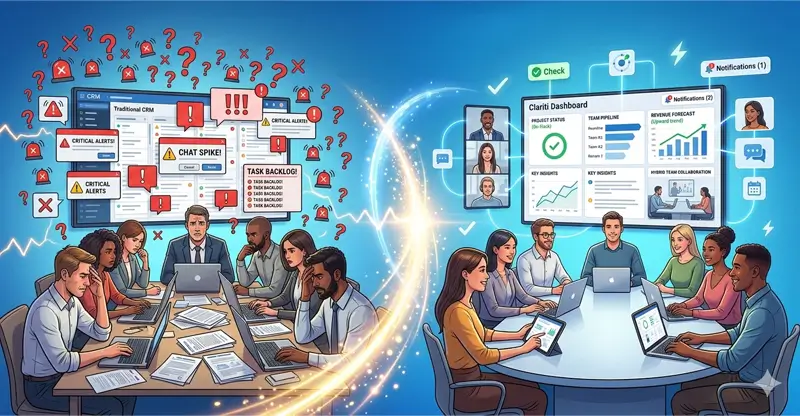
Email has long been the backbone of workplace communication, but for many teams, it has become more of a bottleneck than a solution. Endless email threads, delayed responses, and scattered information make collaboration inefficient, often leading to miscommunication and lost productivity. While emails serve an essential purpose, relying on them as the primary mode of communication can slow teams down, especially in fast-paced work environments where real-time discussions are crucial.
The way teams collaborate is evolving, and Clariti’s hybrid Conversations offer a smarter alternative. Unlike traditional emails that separate discussions from context, Clariti seamlessly integrates emails, chats, shared files, and calls into a single structured hybrid Conversation. This approach ensures that all relevant information stays connected, reducing the need for long email chains and repetitive follow-ups. With Clariti’s hybrid Conversations, teams can switch between email and chat effortlessly while maintaining full context, making collaboration more fluid and efficient.
Embracing Clariti’s hybrid Conversations means breaking free from the limitations of traditional email and adopting a more dynamic, organized communication model. It allows for faster decision-making, better knowledge retention, and improved team collaboration, ensuring that important discussions don’t get buried under an avalanche of emails.
If your team is still struggling with email overload, it may be time to transition to a system that streamlines communication and enhances productivity. In this blog, we’ll explore how Clariti’s hybrid Conversations can transform the way teams work and why making the switch is essential for modern businesses.
Problems with Sticking to Email for Communication
- Lack of Real-Time Interaction – Email is inherently slow, making real-time collaboration difficult. Waiting for responses delays decision-making, especially when quick back-and-forth discussions are needed.
- Overloaded Inboxes – Important messages get buried under promotional emails, automated notifications, and lengthy threads. This makes it hard to track conversations and find relevant information when needed.
- Fragmented Communication – Email-only communication separates discussions from context. Teams often resort to multiple email chains, leading to confusion and making it difficult to follow past conversations.
- Difficulty in Managing Attachments – Files shared over email get lost in long threads, requiring multiple downloads and version tracking issues. This results in unnecessary duplication and wasted time.
- Lack of Accountability and Visibility – Emails don’t provide clear ownership or task tracking. Without a structured communication system, follow-ups are often missed, and team members struggle to stay aligned.
- Security and Compliance Risks – Emails are vulnerable to phishing attacks, unauthorized access, and accidental forwarding. Sensitive business information can easily be compromised if not handled securely.
- Disruptive Notifications – Unlike chat-based collaboration tools, emails come with constant, unstructured notifications that disrupt workflow, leading to reduced focus and productivity.
- No Seamless Integration with Other Tools – Email doesn’t naturally integrate with other business tools like calendars, project management, or file-sharing platforms, making workflows inefficient.
Shifting to Clariti’s hybrid Conversations, which blend emails with chats, shared files, and calls in context, eliminates these inefficiencies and makes collaboration more seamless.
Reluctance to Use Clariti’s Hybrid Conversations
Despite the clear advantages of hybrid Conversations, some teams may be hesitant to move away from traditional email-based communication. Here are some common reasons for this reluctance and why they shouldn’t hold teams back:
- Comfort with Email – Many teams are deeply accustomed to using email and may resist change due to familiarity. However, Clariti’s hybrid Conversations don’t eliminate email; they enhance it by linking emails with chats, files, and calls for better context and efficiency.
- Fear of Learning a New System – Adopting a new tool can seem overwhelming, but Clariti is designed for ease of use. It naturally organizes conversations without requiring users to manually sort emails and chats, making the transition smooth.
- Concerns About Implementation Disruptions – Businesses worry that switching to a new system might disrupt ongoing workflows. Clariti, however, integrates seamlessly with email, meaning teams can gradually adopt hybrid Conversations without losing existing communications.
- Perceived Lack of Need – Some teams may believe their current system works fine. However, as email overload grows and conversations become fragmented, the inefficiencies of traditional email become more apparent, making a structured approach like Clariti’s hybrid Conversations a necessity.
- Uncertainty About Adoption Across Teams – A common concern is whether the entire team will adopt the new workflow. With Clariti, team members can start using hybrid Conversations gradually while still communicating via email when needed, ensuring a flexible and inclusive transition.
Overcoming these hesitations is key to improving collaboration and productivity. Teams that embrace Clariti’s hybrid Conversations experience more streamlined communication, better organization, and fewer email-related inefficiencies.
How to Educate Team Managers on the Value of Clariti’s Hybrid Conversations
- Show How It Solves Common Communication Issues – Managers often deal with scattered emails, lost chats, and follow-up delays. Demonstrating how Clariti’s hybrid Conversations keep everything connected—emails, chats, documents, and calls—helps them see its value in improving workflow efficiency.
- Highlight Time Savings and Productivity Gains – Managers need clear, actionable insights without sifting through multiple email chains. Show how Clariti’s hybrid Conversations reduce time spent searching for information, managing emails, and following up on tasks.
- Demonstrate Real-World Scenarios – Use practical examples to illustrate how Clariti helps teams stay organized. For instance, a sales manager can track all client communication—including emails, chat discussions, and shared files—without switching between platforms.
- Offer Hands-On Training and Workshops – Conduct live demos and training sessions where managers can experience Clariti’s hybrid Conversations in action. Address their concerns and show how Clariti integrates seamlessly with their existing workflow.
- Showcase How It Enhances Team Accountability – Managers can see who said what, when, and why, making it easier to track progress, reduce miscommunication, and ensure everyone is aligned on key decisions.
- Encourage Gradual Adoption – Instead of forcing an immediate switch, allow managers to use Clariti’s hybrid Conversations alongside traditional email. As they see its effectiveness, they’ll naturally encourage their teams to transition.
- Provide Metrics and Data-Driven Insights – Share case studies or internal reports on how teams using Clariti experience faster decision-making, improved collaboration, and fewer email-related inefficiencies.
Educating managers on the value of Clariti’s hybrid Conversations ensures they lead by example, making it easier for teams to embrace a more organized and efficient communication model.
How to Incentivize Employees to Move from Chat and Email to Clariti’s Hybrid Conversations
- Demonstrate the Efficiency Gains – Show employees how Clariti’s hybrid Conversations reduce email overload and prevent scattered chat discussions. Highlight real-life examples where finding information quickly or reducing back-and-forth improved productivity.
- Gradual Transition with Minimal Disruption – Instead of enforcing an abrupt shift, encourage employees to use Clariti’s hybrid Conversations alongside emails and chats. As they experience the benefits—like connected discussions and reduced miscommunication—they’ll naturally adopt the new approach.
- Provide Hands-On Training and Support – Offer step-by-step onboarding, tutorials, and Q&A sessions to help employees feel comfortable using Clariti. A well-supported transition minimizes resistance and increases adoption.
- Recognize and Reward Adoption – Incentivize employees who actively use Clariti’s hybrid Conversations by recognizing their efforts in team meetings or offering small rewards. Positive reinforcement fosters enthusiasm for the new system.
- Highlight Reduced Meeting and Follow-Up Burden – Show how Clariti’s hybrid Conversations eliminate the need for long email threads and redundant follow-ups. When employees realize they spend less time searching for information, they’ll be more willing to switch.
- Set Clear Expectations – Leaders should actively use Clariti’s hybrid Conversations and set the standard for communication. When managers engage in Clariti’s hybrid Conversations instead of defaulting to email or chat, employees will follow suit.
- Showcase Success Stories – Share examples of how teams using Clariti have improved efficiency, avoided missed information, and collaborated more effectively. Real results help build confidence in the new system.
Encouraging employees to embrace hybrid Conversations requires a mix of education, gradual adoption, and clear communication of benefits. Once they experience the streamlined workflow, the transition becomes easier.
Case study: How Clariti’s Hybrid Conversations Transformed Teamwork
1. Client Overview
A mid-sized IT consulting firm with 150 employees faced significant communication challenges. With multiple client projects running simultaneously, teams relied heavily on email, chat, and various file-sharing platforms to stay connected. However, fragmented conversations, lost context, and excessive email overload created inefficiencies that impacted productivity and decision-making.
2. Challenges
- Email Overload: Team members were overwhelmed with long email threads, making it difficult to track project updates and critical discussions.
- Disjointed Communication: Information was scattered across emails, chats, and documents stored in different locations, leading to confusion and delays.
- Inefficient Collaboration: Employees wasted time switching between multiple apps to find relevant information and coordinate with colleagues.
- Lack of Context in Discussions: Important decisions often lacked historical context, forcing employees to spend extra time piecing together information.
- Difficulty in Tracking Client Communication: Conversations with clients were spread across emails and chat apps, making it hard to maintain a single source of truth.
3. Solution: Implementing Clariti’s Hybrid Conversations
Our client adopted Clariti to integrate emails, chats, calls, shared documents, and calendar events into a single hybrid Conversation. The implementation process involved:
- Migrating ongoing conversations from emails and chat apps into Clariti.
- Training employees on hybrid Conversations to ensure seamless adoption.
- Encouraging teams to use Clariti to consolidate project communication and reduce dependency on email.
4. Results & Impact
- Improved Communication Flow: With hybrid Conversations, teams could easily access all relevant emails, chats, and documents in one place, eliminating the hassle of searching for scattered information.
- Reduced Email Dependency: Email volume dropped by 40% as employees used Clariti’s contextual conversations instead of sending unnecessary emails.
- Faster Decision-Making: With all discussions stored in an organized manner, employees spent 30% less time following up on unresolved issues.
- Increased Team Productivity: Employees saved an average of 5 hours per week by avoiding app-switching and redundant conversations.
- Better Client Management: Client interactions were now part of structured hybrid Conversations, ensuring no critical discussions were lost or forgotten.
- Seamless Collaboration Across Departments: Project teams could easily track historical conversations, reducing the risk of miscommunication and improving cross-functional teamwork.
5. Hybrid Conversations: Game-changer
By adopting Clariti’s hybrid conversations, our client transformed its internal communication, leading to improved collaboration, increased efficiency, and better project execution. With a centralized platform for emails, chats, and documents, the company reduced workflow friction and empowered its teams to focus on meaningful work. The shift to hybrid Conversations was a game-changer, helping our client achieve greater transparency, accountability, and productivity across all departments.
6. Key Takeaways
- Clariti’s hybrid Conversations eliminated scattered communication and reduced email overload.
- Employees experienced a significant boost in efficiency by spending less time searching for information.
- Client interactions became more structured, ensuring seamless follow-ups and improved service delivery.
- Clariti helped create an organized, transparent, and highly collaborative work environment.
Conclusion
In today’s digital-first world, businesses need efficient, context-driven communication to stay competitive. Sticking to outdated email-based collaboration slows down workflows and increases miscommunication.
Clariti’s hybrid Conversations provide a smarter alternative, ensuring teams stay aligned, responsive, and productive. Making the switch is not just about convenience—it’s about empowering teams to work smarter, not harder.


Start for FREE with Personal CRM
We too hate spam! Your email is secure with us.

Spot secured. You're in.
You’re officially on the list for early access to Clariti.


No more switching tools.

No more lost context.

Just Clarity.
You’ll be among the first to experience it when we launch. We’ll let you know the moment it’s ready.

Keep an eye out for emails from @clariti.app.
(and check your spam folder just in case—whitelisting us helps ensure you don’t miss a thing).